This is not a news post. The news has been covered everywhere. This is a post about what most businesses are not seeing yet.
For the last decade, AI has felt like the internet did in the 2000s. Borderless. Available to anyone who could pay. The same tools sitting on your desk in Sydney that sit on a desk in San Francisco. That has been the deal. It has felt permanent.
That assumption has now been quietly retired.
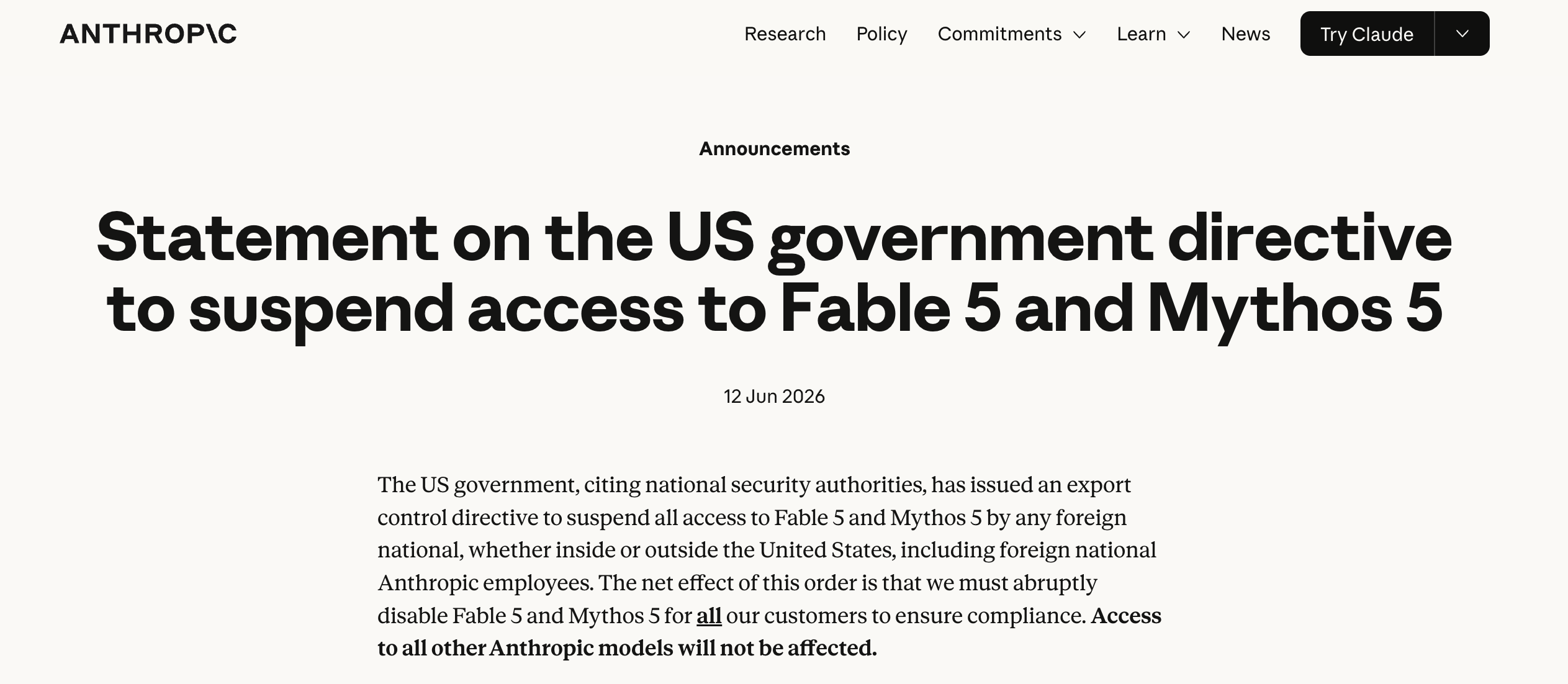
Last Friday the US government issued an emergency directive ordering Anthropic to immediately shut off access to its newest AI models, Claude Fable 5 and Mythos 5, for every foreign national on the planet. Anthropic could not enforce that surgically, so they pulled the models for everyone. Australians, Europeans, Canadians. Switched off in hours.
If you want the full chronology, our piece on Claude Fable 5 walks through what was launched and what happened next. This post is about something bigger. Not the ban itself, but the structural shift it signals. And what Australian business owners and decision-makers actually need to understand about the world that is now forming.
I want to write this as an education piece, not a news piece. So let’s slow down and walk through it properly.
The thirty-year assumption that just broke
Here is what I think most businesses are missing.
The Fable 5 ban was not really about Fable 5. It was about a category shift in how the world treats frontier AI.
For thirty years, software has worked on one rule: capability flows to whoever can pay for it. Geography does not matter. A startup in Brisbane gets the same tools as a Fortune 500 in New York. That rule has been so consistent for so long that we have built entire business models on top of it, often without noticing.
Look at what we have done. We have moved our customer support to global SaaS platforms. We have built operational workflows on top of US AI APIs. We have made productivity assumptions that quietly depend on a single overseas provider remaining available to us. None of those decisions felt risky at the time because the rule felt permanent.
Last Friday demonstrated that the rule has changed. Frontier AI is being reclassified from a software product to a strategic asset. The same way nuclear technology is treated. The same way advanced semiconductors are treated. The same way encryption was treated in the 1990s. Governments have always controlled strategic assets. AI just joined the list.
And here is the part Australian businesses need to sit with: this is not a one-off. It is the first time a US export control directive has been used to pull a publicly deployed AI model offline. Crossed precedents do not tend to uncross.
Why SaaS is sliding and bespoke is rising
Here is something I noticed in the days following the ban that I think most people missed.
Pull up the share price of any major enterprise SaaS company over the past week. Workday. Salesforce. Oracle. They all started sliding the same week Fable 5 launched, and the slide continued through the ban. Not by huge amounts, but enough to notice. And the curves look almost identical across all of them.
That is not a coincidence. And it is not just about Fable 5.
What I think investors are starting to price in is a much bigger shift. Bespoke is becoming cheaper to build than off-the-shelf. With a model like Fable 5, a business with one technically literate person can build a custom internal tool that does what they used to pay a SaaS subscription for. The economics that made SaaS dominant for the last 15 years, which was essentially ‘it is too expensive to build your own, so just rent it’, are starting to weaken.
Mix that with the Fable ban, and you get a doubly uncomfortable position for businesses that have built operations on heavy SaaS dependency. The tools are getting easier to replace, and the tools you depend on can also be switched off. Neither of those is a five-alarm fire on its own. Together, they describe a market that is moving faster than most companies’ tech strategies are.
The Australian detail that did not make the global coverage
This is the part that hit me hardest when I dug into the timeline.
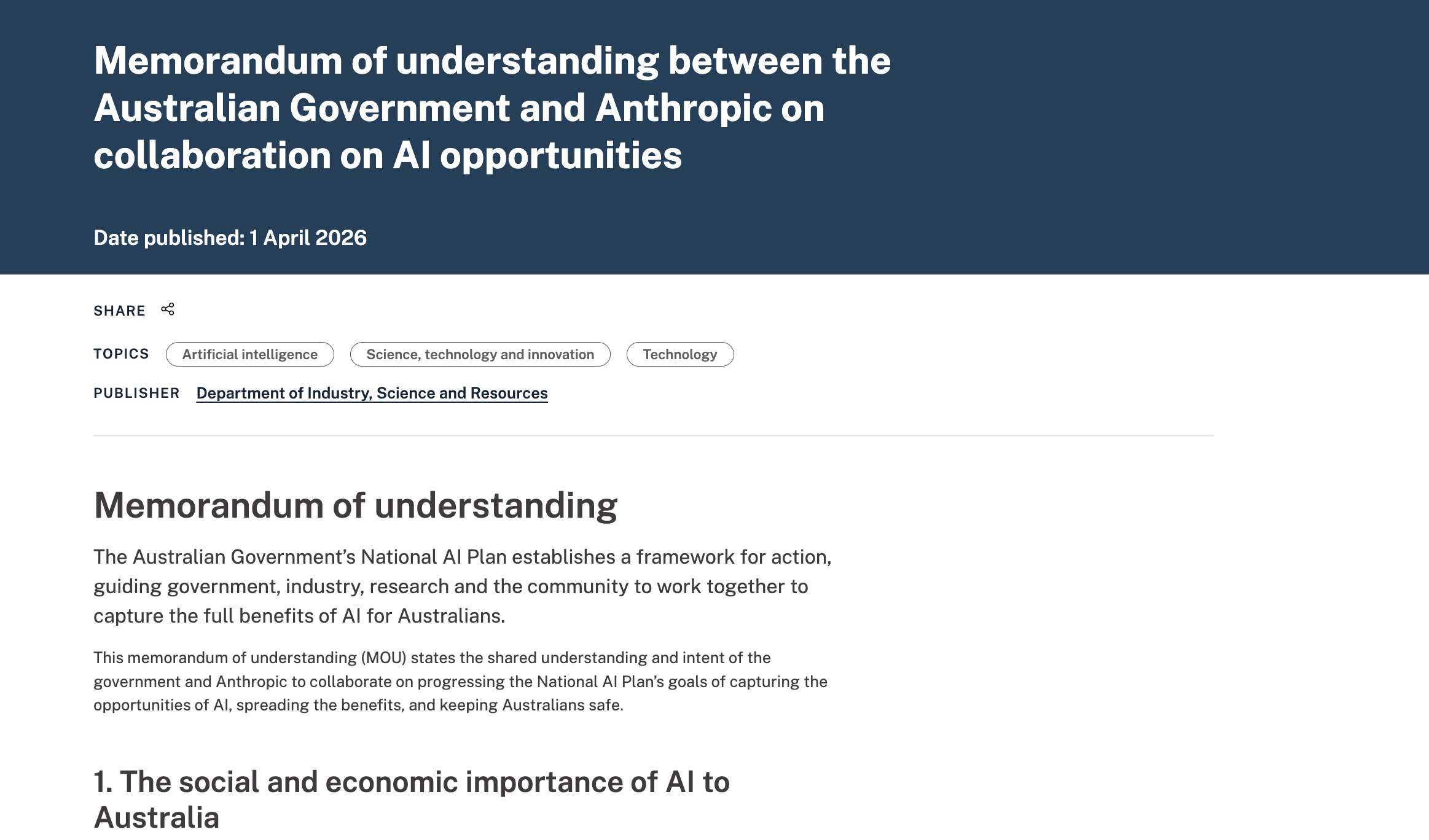
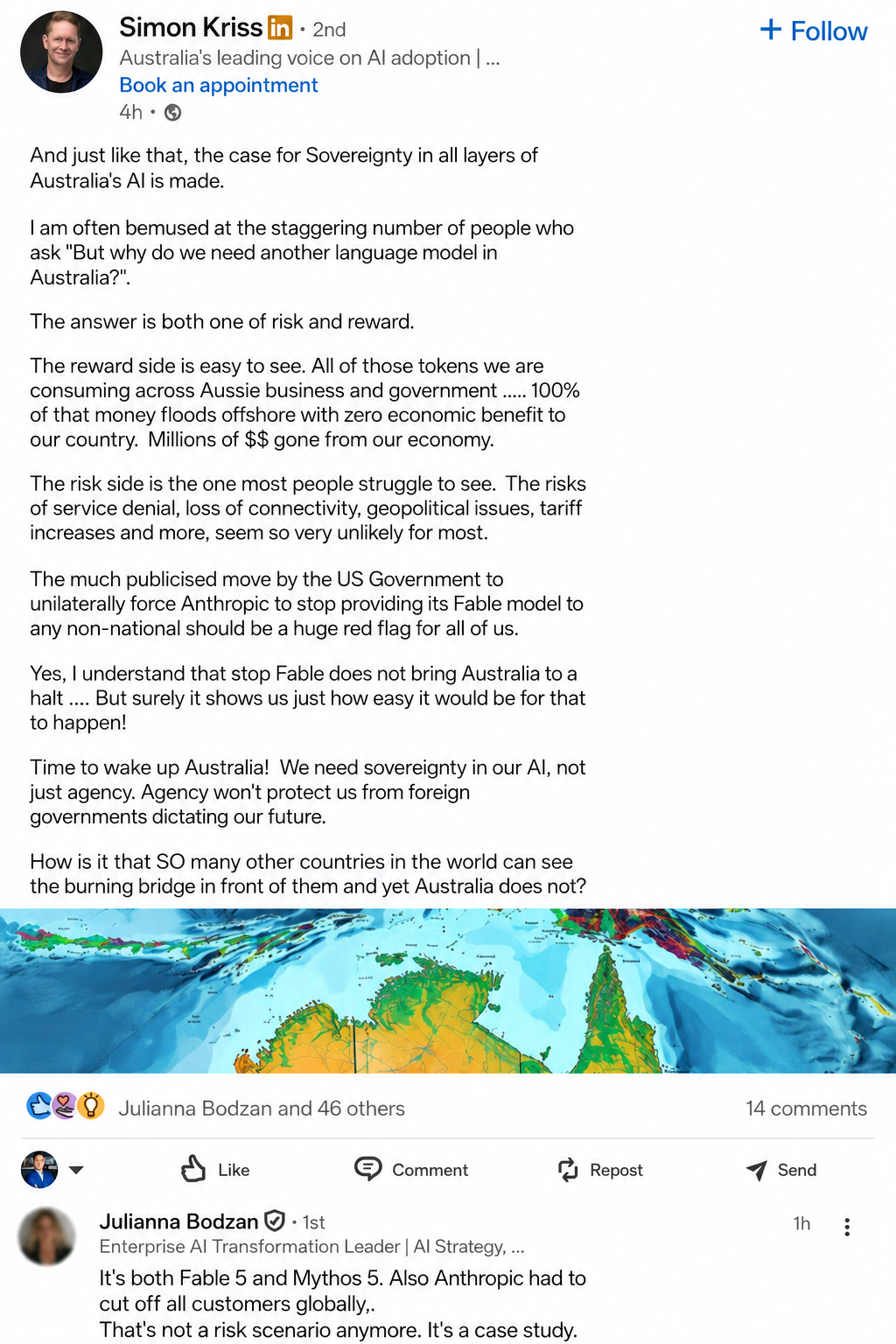
In April this year, the Australian Government signed a formal Memorandum of Understanding with Anthropic. The Minister for Industry, Tim Ayres, signed it. Dario Amodei signed it personally for Anthropic. It covered local AI investment, a planned Sydney office, research partnerships, and skills development. The Australian Government’s own announcement made a point of saying that Australians are among the highest per capita users of Claude in the world.
Two months later, on 12 June, that MoU did not matter at all.
When the US export control directive came through, every Australian Claude user was classified as a foreign national. The MoU we had signed at ministerial level did not provide protection. Being a Five Eyes intelligence ally did not provide protection. The fact that Anthropic was planning to invest commercially in Sydney did not provide protection.
I am not saying that to be alarmist. Anthropic is not the problem here. Dario Amodei is not the problem. The directive operated above the level of commercial agreements. It was a national security action that sat in a layer above any commercial or diplomatic relationship Anthropic could have built with Australia.
That is the structural insight. And it is one most Australian businesses have not yet absorbed.
What this is not
Before going further, let me be clear about what I am not saying.
I am not saying stop using Claude. We use it every day. It is a genuinely transformative tool for the businesses we work with. I am not saying Anthropic acted badly. From what I have read, they pushed back on the directive and complied because they had to. I am not saying the US government acted unreasonably either. National security decisions involve information none of us can see from where we are sitting.
What I am saying is that the assumption a lot of Australian businesses have been operating under, that access to any global AI tool is essentially guaranteed as long as we pay for it, was just stress-tested. And it failed.
The question is not whether this kind of disruption can happen. It already did. The question is what to do about it.
What Australian businesses should actually take from this
I wrote about how the businesses that adapted to the Industrial Revolution were the ones we still know today. Ford did not just buy machines. Ford rebuilt the production process around what machines made possible. The competitors who treated machines as an add-on to existing factories got crushed.
The same dynamic is happening with AI right now. The businesses that treat AI as a tool to bolt onto existing operations are going to be outcompeted by businesses that redesign their operations around what AI now makes possible. The Fable ban does not change that thesis. It sharpens it. Because the businesses that adapt thoughtfully also need to be the ones whose adaptation does not break the first time access changes.
That is the real lesson. AI fragmentation is the new structural shift. The businesses that adapt their architecture to it now will look very different in five years from the ones that do not. Building AI-resilient architecture is the Ford assembly line decision of this moment.
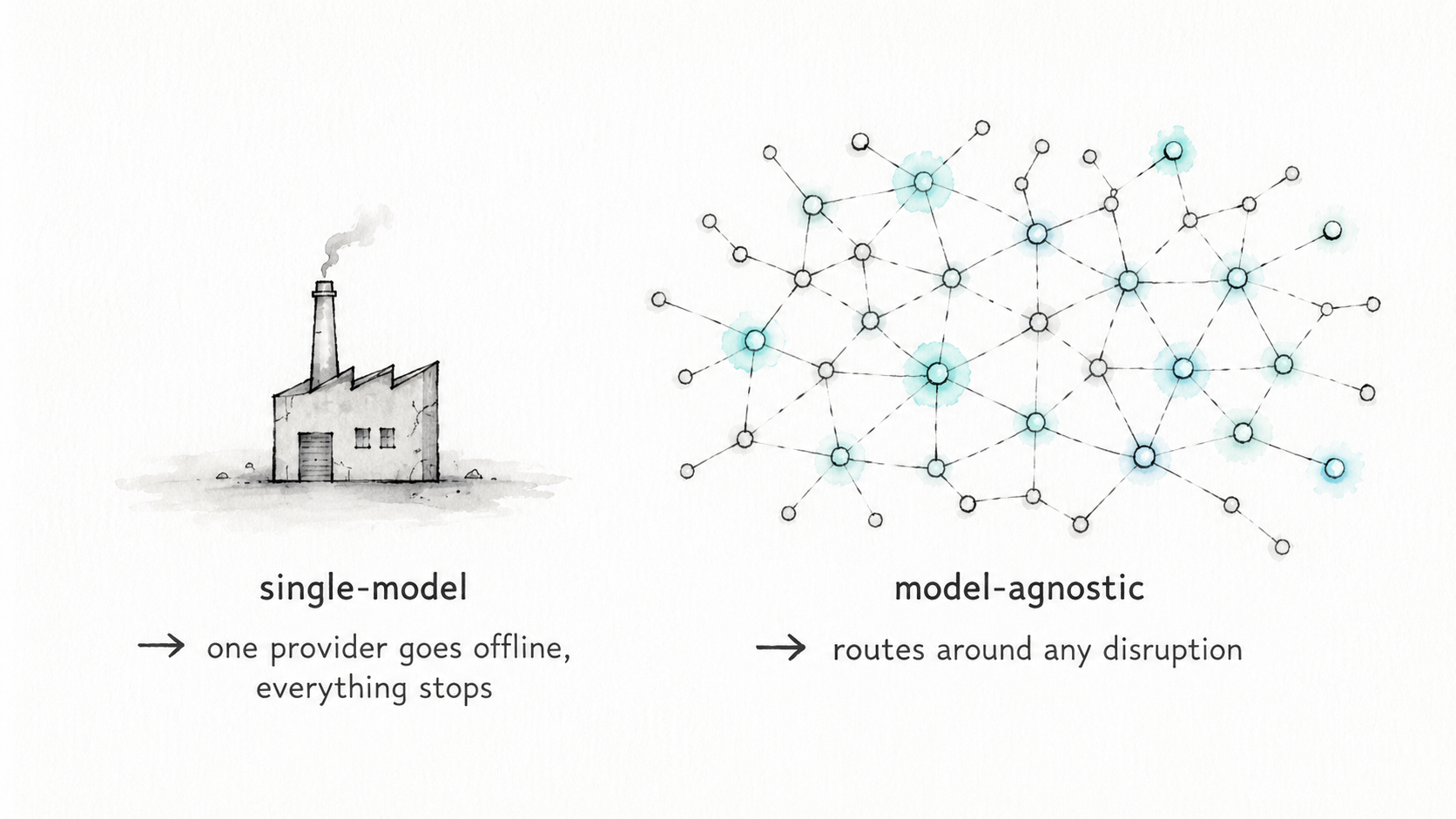
So what does adaptation actually look like in practice. There are three concepts worth understanding properly, because they will come up again and again over the next few years.
Concept one: single points of failure
Every business has them. Most businesses do not map them. The exercise is simple. Walk through your operations. For every process that now involves AI, ask one question: if this specific model disappeared tomorrow, what breaks. Some answers will be small. Drafting emails is fine, you can switch tools easily. Some answers will be bigger. Customer service flows, automated decision systems, content pipelines, document processing. Knowing where your single points of failure are is half the work. Most businesses skip this step because they have never had to think about it.
Concept two: model-agnostic architecture
This is the most important concept in the post. Model-agnostic means designing your AI systems so they do not depend on any single model or provider. The businesses least disrupted last Friday were the ones who had built AI automation in a way that did not depend on any single model. They could swap between Claude, GPT-4, Gemini, or open-source alternatives without rebuilding from scratch. That capability used to be a nice-to-have. Last week it became the difference between operations running normally and operations not running at all. From a design perspective, model-agnostic architecture is what protects you against three different categories of risk at once: provider outages, sudden pricing changes, and geopolitical access restrictions like this one.
Concept three: AI access as supply chain risk
After 2022, every serious business added semiconductor supply chain risk to their thinking. We learned how exposed global operations were when chip access changed. AI access risk is now in the same category, but most businesses have not added it to their risk register yet. This is the gap. AI dependency belongs in board-level risk discussions, business continuity plans, and vendor evaluations. The exact same way you would assess any other supply chain dependency in your business. The thinking model already exists. It just needs to be extended.
Zooming out: where this is heading
If you take one thing from this post, take this.
Software was supposed to be the great global equaliser. A founder in Lagos and a founder in London were meant to have access to the same tools. For thirty years, that mostly held. AI is the first technology in that lineage where the equaliser premise is breaking openly, and it is breaking at exactly the moment AI is becoming the most economically valuable thing in software.
So we get to a strange dual reality. AI is the most important productive technology of our generation. It is also the most likely technology to be controlled by governments going forward. Both of those things are true at the same time, and both will shape every business decision around technology for the next decade.
What that means in practical terms is that being a smart user of AI is no longer enough. You also need to be a smart architect of where you put your AI dependencies. Geography is back in software. Most businesses have not updated their thinking yet. The ones that do will have a real competitive advantage when the next directive arrives. Because there will be a next one.
One last thought
The Fable 5 ban itself might be reversed. Anthropic has said they believe it is a misunderstanding and they are working to resolve it. I hope they do.
But hoping that this specific incident gets resolved is not the same as understanding the world that produced it. That world is the one to plan for.
The lesson is not ‘Fable 5 got switched off.’ The lesson is that we are entering a phase where AI capability, market structure, and geopolitics are starting to move together rather than separately. Businesses that understand that early will design themselves differently from businesses that do not.
That is the entire point of this post. Not to make anyone alarmed about Fable 5. To make sure Australian business owners are not still operating on the assumption that AI access is a fixed input. It is not. And the businesses that internalise that, and design around it, will be the ones still standing when the next change arrives.
Fabrice Jiew is CEO and co-founder of Automation Consulting, one of Australia’s original automation consultancies. He works with businesses across retail, fintech, and professional services to build AI and automation systems that are designed to last beyond any single tool.
Common questions
AI fragmentation refers to the emerging reality that access to frontier AI tools is no longer borderless. The US government’s June 2026 directive ordering Anthropic to suspend Fable 5 and Mythos 5 for all foreign nationals was the first time a publicly deployed AI model was pulled offline by export controls. For Australian businesses, it means AI tools they depend on can now be removed by foreign government action with no warning, regardless of commercial agreements or diplomatic ties.
No. The MoU signed between the Australian Government and Anthropic in April 2026 operated at a commercial and diplomatic level. The US Commerce Department’s directive operated under national security export controls, which sit above commercial agreements. Australian businesses lost access to Fable 5 and Mythos 5 alongside users worldwide.
Model-agnostic architecture means designing AI-powered systems so they are not dependent on any single AI model or provider. A model-agnostic system can swap between Claude, GPT-4, Gemini, or open-source models without requiring a rebuild. After the Fable 5 ban, businesses with model-agnostic architectures were largely unaffected, while businesses with single-model dependencies lost workflows overnight.
No. The recommendation is not to stop using these tools but to stop assuming continuous access is guaranteed. Building model-agnostic systems means continuing to use the best available tools while preserving the ability to switch if access is disrupted.
Three steps are recommended. First, audit your AI dependencies to identify single points of failure in your operational workflows. Second, design for portability so that your AI systems can switch providers without rebuilding from scratch. Third, treat AI access as a supply chain risk category and include it in business continuity planning and vendor risk assessments at board level.
The Fable 5 directive is the first time the US has used export controls to remove a commercially deployed AI model from public access, but it follows a broader pattern. Earlier in 2026, Anthropic was declared a US supply chain risk and faced separate federal litigation. Forrester predicts that more than half of APAC firms will be investing in sovereign AI infrastructure in 2026. The direction of travel suggests AI fragmentation is structural, not a one-off event.