Anthropic’s most capable model to date, Claude Fable 5 launched June 2026. Unlike previous releases, it’s designed to handle long, autonomous work without hand-holding – think multi-hour tasks, not just better chat.
Every few months, a new AI model drops and the internet goes into a frenzy. Usually it’s developers sharing things that are genuinely impressive but hard to connect to the reality of running a business or managing a team.
Right now that model is Claude Fable 5, and the hype is real. But so is the confusion.
So rather than tell you it’s the best thing ever, we want to share what we’re actually thinking about it – the opportunities, the complications, and what might be worth doing right now if you’re a manager or decision-maker who uses Claude in any part of your work.
What actually just happened?
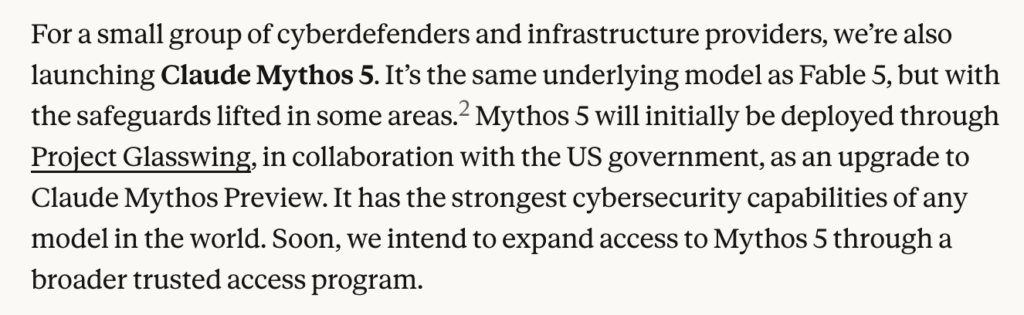
Anthropic released two models simultaneously: Claude Fable 5 (available to everyone) and Claude Mythos 5 (restricted to select government and security partners through a program called Project Glasswing).
Here’s the thing most articles skip over: they’re the same underlying model. The only real difference is which restrictions are active. Fable 5 is Mythos 5 with safety guardrails on. Mythos 5 is for vetted institutions where some of those guardrails are lifted.
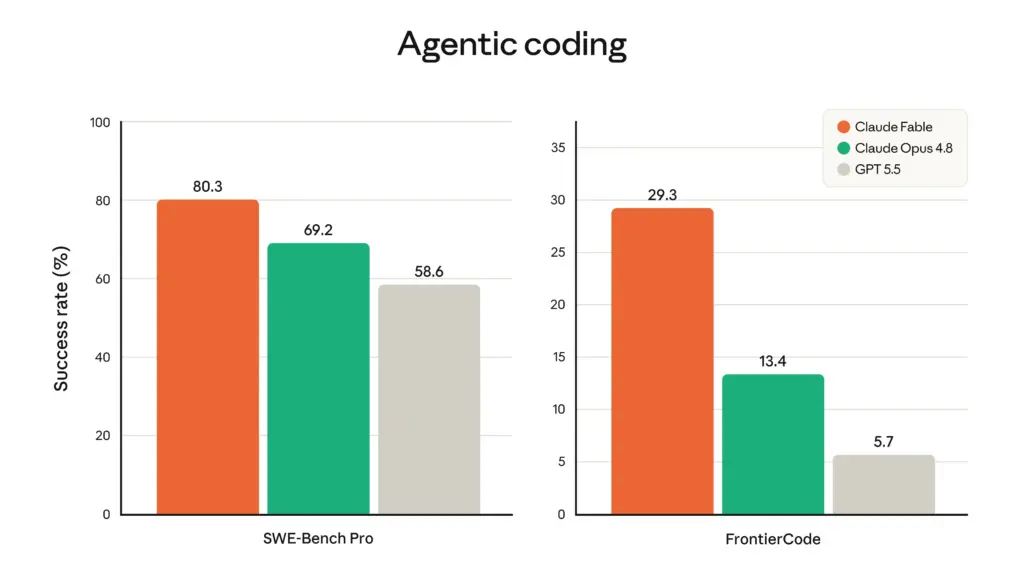
Where does Fable 5 sit in the lineup? Think of it as a new tier sitting above Opus. The Claude hierarchy now runs Haiku → Sonnet → Opus → Fable. Fable is the new ceiling for regular business users.
What does that actually mean in practice?
Less “slightly better at writing emails” and more “can handle a complex, multi-step project autonomously for hours — and check its own work along the way.” Stripe reportedly used it to complete a codebase migration in a single day that their team estimated would take two months by hand. An independent developer built and shipped an entire software library release in one day — work he estimated would normally take several days.
That’s not a marginal improvement. That’s a different category of usefulness – for the right kind of work. More on that below.
What Claude Fable 5 actually costs
This is the part that decides whether Fable 5 is worth it for your team.
Fable 5 isn’t included in every Claude plan the way Opus is. On Max plans, and on premium seats on Team and Enterprise plans, it’s a standard part of the plan – you can put up to half your weekly usage limit through Fable 5 at no extra cost. On Pro plans, and on standard Team and Enterprise seats, it isn’t included in your plan’s limits at all: it runs on pay-as-you-go usage credits you buy on top of your subscription. Through the API it’s billed at standard rates – $10 per million input tokens and $50 per million output tokens, roughly double what Opus costs.
The practical read: test before you budget. Run a narrow slice of your team’s real work through Fable 5 and see whether the output is genuinely better before you either hand over half a weekly usage limit or start buying credits. For most teams the honest answer will be that it earns its price on a handful of jobs and is overkill for the rest.
One thing worth noting on usage speed: Early users have reported Fable 5 burns through usage limits faster than previous models. This is something we’ve seen with every major Claude release – more capable models are more compute-intensive, which means they use more of your allocated usage per task. It does make sense given how much more reasoning the model does. Anthropic has signalled they’re working to improve this over time, but for now it’s worth factoring in if you’re on a plan with a weekly usage cap.
The part that might actually frustrate your team
This is something Anthropic is transparent about, but worth explaining clearly because it affects day-to-day usability.
Fable 5 doesn’t always respond as Fable 5.
Because the underlying model is exceptionally capable in areas like cybersecurity and biological research, every request runs through a layer of safety classifiers. When a request touches certain topics — cybersecurity, biology, chemistry — the system automatically routes the query to Opus 4.8 instead. You get told this is happening, but you can’t override it.
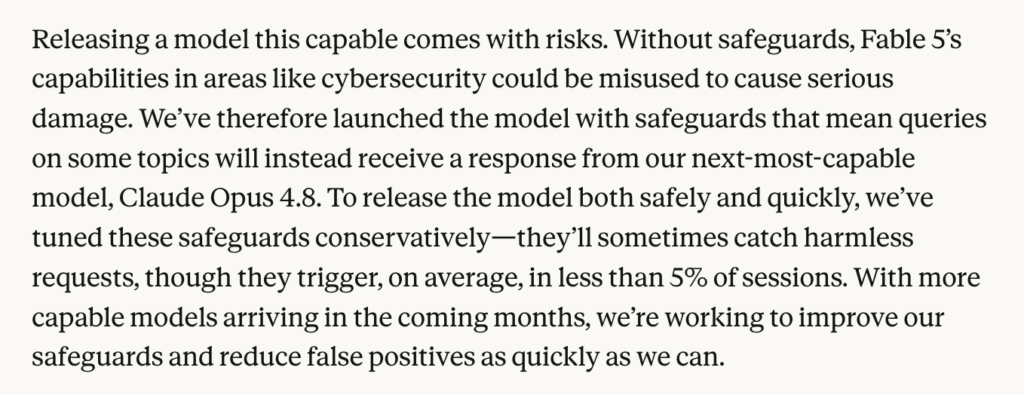
Even though Anthropic says this affects fewer than 5% of sessions on average, early user reports in the first 48 hours included some surprising examples – prompts about pulled pork shopping lists, basic biology questions, and even asking about the filters themselves apparently triggered a downgrade to Opus. That said, Anthropic designed the classifiers to be deliberately over-tuned at launch, with plans to reduce false positives over time
There’s one piece of good news here: you won’t be charged Fable prices for requests that get rerouted to Opus 4.8. So at least the fallback won’t cost you extra.
Where Fable 5 is actually worth it?
Fable 5’s edge isn’t in short, single-turn tasks. If your team is using Claude to draft emails, summarise documents, or answer quick questions, Opus 4.8 handles those perfectly well. The premium isn’t worth it for that.
Where Fable 5 is genuinely different: work that runs long, requires holding a lot of context, involves checking its own outputs, or needs to coordinate across multiple steps without hand-holding.
Anthropic describes it as built for “days-long, complex, and asynchronous tasks previous models couldn’t sustain” – running in agent harnesses, planning across stages, delegating to sub-agents, and checking its own work. That’s the real differentiator.
Here’s how that shows up across different roles:
| Marketing managers and brand teams |
| Running a full campaign brief that requires synthesising customer research, competitive analysis, and performance data from multiple sources, then producing a structured, reviewable output in a single session. Fable 5 can carry start to finish while flagging its own uncertainties along the way. |
| Finance and operations leaders |
| Working through multi-stage scenario analysis where each step informs the next – reasoning through the implications, checking internal consistency, and producing a board-ready output. Early testing found it scored highest of any model on Hebbia’s Finance Benchmark for senior-level reasoning, with double-digit gains in document reasoning, chart and table interpretation. |
| Legal and compliance teams |
| Reviewing a stack of contracts or regulatory documents and producing a structured risk summary – reasoning about what it means and flagging inconsistencies across documents. In blind review, lawyers found its redlines matched or beat their existing model every time. |
| Project and operations managers |
| Handing off a complex brief – say, restructuring a supplier agreement or building an operational process document – and getting back a draft that’s genuinely ready to review rather than a starting point that needs significant rework. The model proactively fills in gaps rather than stopping to ask about them. |
| Retail and ecommerce teams |
| Post-campaign analysis that requires pulling together performance data, customer feedback signals, and market context then producing a clear “what worked, what didn’t, what next” synthesis. Particularly useful where the analysis needs to span multiple channels and data types in one coherent output. |
| Property and infrastructure teams |
| Tender or proposal preparation that requires synthesising project specs, compliance requirements, cost estimates, and precedent documents into a structured submission-ready document. The model’s ability to maintain coherence across a long, multi-part document is where the upgrade shows up. |
The common thread: the more moving parts, the longer the task needs to run, and the more the output needs to be self-consistent — the more Fable 5’s improvements actually matter.
In most of those examples the model is the easy part. The value shows up when it’s wired into the systems the work already lives in – the CRM, the ERP, the document store – so the output lands where someone can act on it. That wiring is the workflow automation work we do every week.
The bigger shift worth watching
Something worth naming beyond just this model release.
For the first time, a frontier AI capability has been formally split into two versions – a public version with restrictions, and a restricted version for trusted institutions. Governments, approved security firms, and select research organisations have access to capabilities that are deliberately unavailable to everyone else.
This might be the right call. The arguments for it are serious and worth respecting. But it does mean AI advantage is starting to become partly a function of your relationship with the AI provider, not just your willingness to pay or your technical capability.
For most businesses today, this is background context. But it’s a pattern worth watching.
What to actually do about it?
Run your real workflows, not demo prompts. Pick the 10-20 tasks your team actually does in Claude every week and run them through Fable 5. Note what’s better, what falls back to Opus, and form a real view before committing. If picking those 10-20 tasks is itself the hard part, that’s a process-mapping exercise more than an AI one, and it’s where our process automation consulting work usually starts.
The model is genuinely impressive for the right kind of work. The rollout has some real rough edges. And there’s more to figure out about how businesses will actually use it once the dust settles.
We’re still working through that ourselves. If you’re doing the same, we’d be happy to think through it with you – we spend our days turning this kind of capability into systems that actually move revenue, and we’ll happily start with 20 hours of free work on a workflow you pick.
Common questions
It depends which plan you’re on. On Max plans, and on premium seats on Team and Enterprise plans, Fable 5 is included – you can use up to 50% of your weekly usage limits on it at no extra cost. On Pro plans, and on standard Team and Enterprise seats, it isn’t included in your plan’s usage limits and runs on pay-as-you-go usage credits instead. Through the API it’s billed at standard rates: $10 per million input tokens and $50 per million output tokens.
It depends entirely on how your team uses Claude. For short, single-turn tasks – drafting emails, quick summaries, answering questions – Opus 4.8 does the job at half the price. Fable 5 earns its premium on long, multi-step work where the output needs to be coherent start to finish and ready to use without significant rework. If you’re unsure, test your real workflows on it before you commit credits or hand over half a weekly limit, and decide based on what you actually observe.
When Fable 5’s safety classifiers detect a request touching certain topics – cybersecurity, biology, chemistry, or model distillation – it automatically hands the request to Opus 4.8 instead. You’ll be notified when this happens. Importantly, you won’t be charged Fable 5 rates for requests that get rerouted – those draw from Opus 4.8 usage instead.
They’re the same underlying model. Fable 5 is the publicly available version with safety restrictions active, meaning certain high-risk query types are routed to Opus 4.8. Mythos 5 is restricted to vetted government and security partners through Project Glasswing, with some of those restrictions lifted. For the vast majority of business use cases, the difference is irrelevant.
See more Automation Consulting insights in your search results
Tell Google you’d like more of our thinking, and the next piece turns up where you’re already looking.