Fable 5’s free-access window has been extended to July 19, 11:59:59 PM PT. After that, it’s usage credits at $10/$50 per million tokens, double Opus 4.8. We covered what to build before the deadline here. This post is about making whatever time you’ve got left go further.
None of what follows is “just use it less.” These are six specific, sourced techniques people are actually running, with the real numbers.
The short version:
- Drop the effort level: Most tasks don’t need max effort, the accuracy gap is smaller than the cost gap.
- Let Fable plan, let a cheaper model execute (and vice versa for research): Anthropic’s own advisor tool cuts cost 11.9–85% depending on the pairing; for anything needing current information, have a cheaper model research first via
/deep-research, then hand the findings to Fable to plan. - Try pxpipe: a free proxy that renders your background context (not your live message) as images, ~59–70% lower bills, but lossy for exact strings buried in that history.
- Add Ponytail: a “write less code” skill, ~54% less code and ~20% lower token cost, independently corrected down from an inflated first claim.
- Clean up your inputs: compress noisy output, route by model,
/compactoften; one developer cut usage ~40–70% doing this alone. - Fix your file formats: Markdown over PDF saves 65–90%; crop screenshots instead of uploading them full-size.
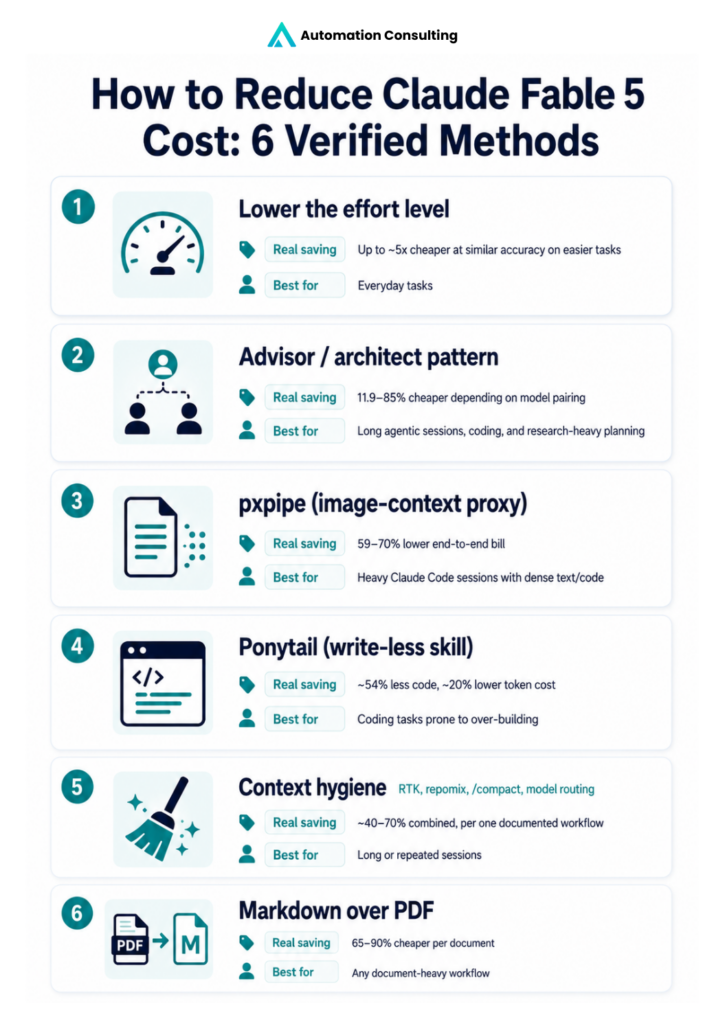
| Method | Real saving | Best for | Watch out for |
|---|---|---|---|
| Lower the effort level | Up to ~5x cheaper at similar accuracy on easier tasks | Everyday tasks, not genuinely hard problems | Real accuracy drop on the hardest tasks |
| Advisor / architect pattern | 11.9–85% cheaper depending on model pairing | Long agentic sessions, coding, and research-heavy planning | Only helps if the cheaper model can genuinely handle its half of the split |
| pxpipe (image-context proxy) | 59–70% lower end-to-end bill | Heavy Claude Code sessions with dense text/code | Lossy on exact IDs, hashes, long numbers |
| Ponytail (write-less skill) | ~54% less code, ~20% lower token cost | Coding tasks prone to over-building | Gains near zero on already-minimal code |
| Context hygiene (RTK, repomix, /compact, model routing) | ~40–70% combined, per one documented workflow | Anyone running long or repeated sessions | Takes setup time upfront |
| Markdown over PDF | 65–90% cheaper per document | Any document-heavy workflow | Complex visual layouts can lose fidelity in conversion |
1. Drop the effort level. Seriously!
By default, Fable 5 runs on a fairly high effort setting, and most people never touch it. Anthropic’s own benchmark data shows why that’s expensive: on FrontierCode Diamond, accuracy climbs from about 11.5% at low effort to roughly 30.9% at extra-high – real gains, but not gains that every task needs. On SWE-bench Pro, the spread is smaller: 75.0% at low effort versus 80.4% at extra-high.
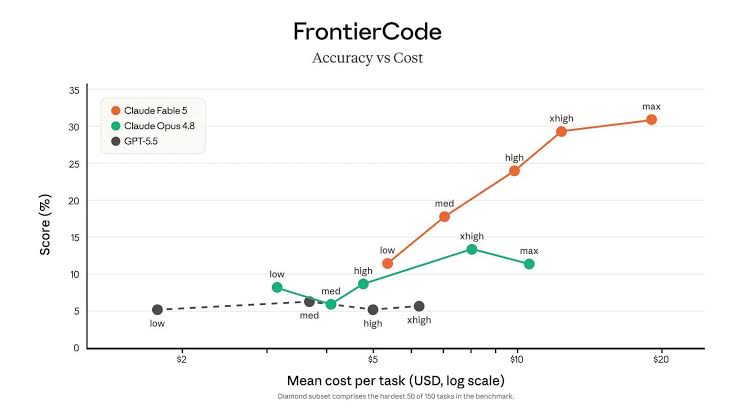
That means: if your task isn’t genuinely hard — a web tweak, a straightforward edit, a routine question — running it on max effort is paying architect rates for a job that doesn’t need one. Drop to medium or low with /effort and see how the output holds up first.
2. Make Fable the architect, not the typist
Anthropic has an actual feature for this: the advisor tool. Instead of running Fable 5 for an entire session, you let a cheaper model (Sonnet or Haiku) execute the task end-to-end, and only escalate to a stronger model when it hits something it can’t resolve alone.
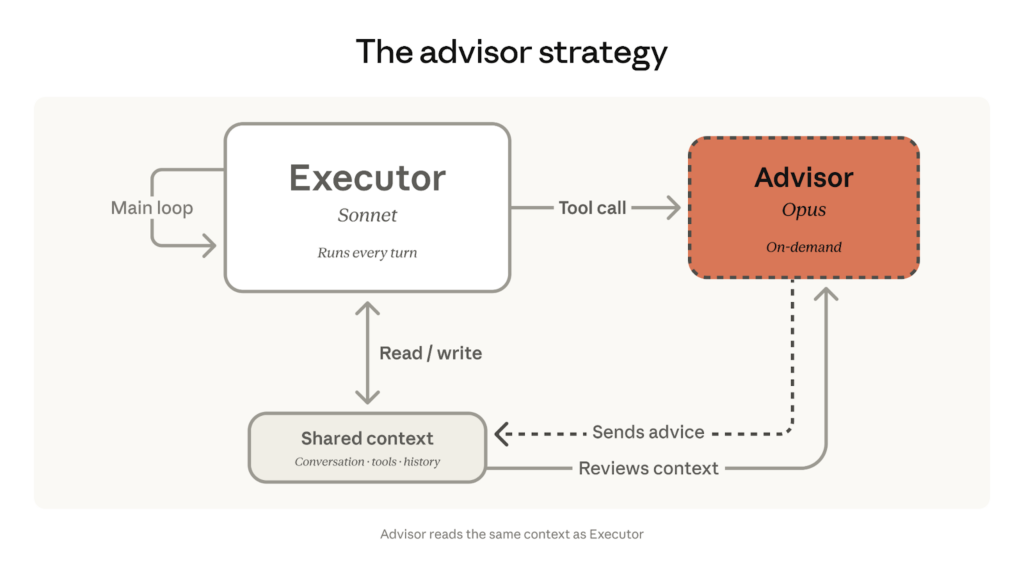
The published numbers are real and specific: Sonnet with an Opus advisor cost 11.9% less than running Opus solo while scoring slightly higher on SWE-bench Multilingual.
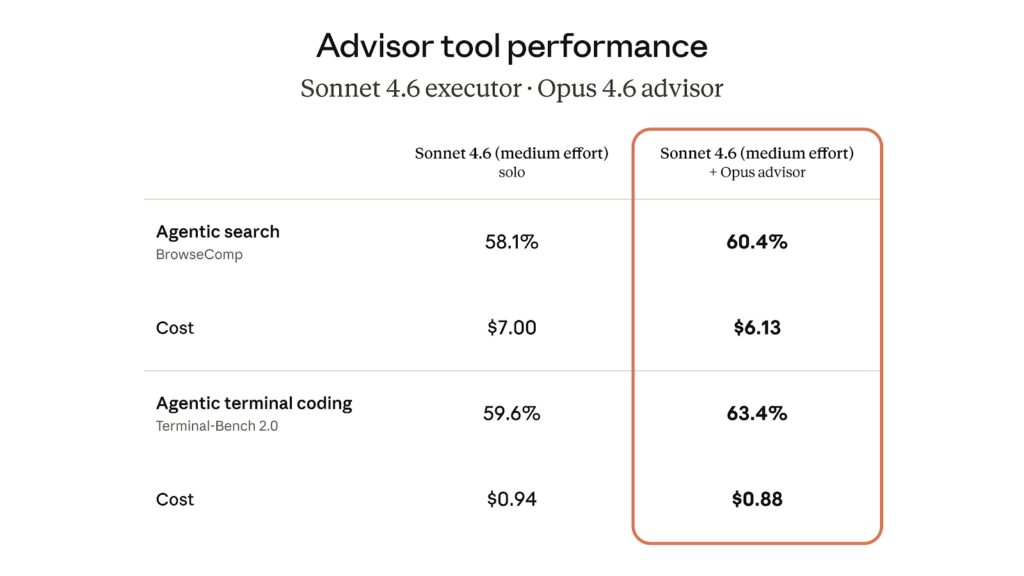
Haiku with an Opus advisor cost 85% less than running Sonnet alone, while roughly doubling Haiku’s score on a hard benchmark.
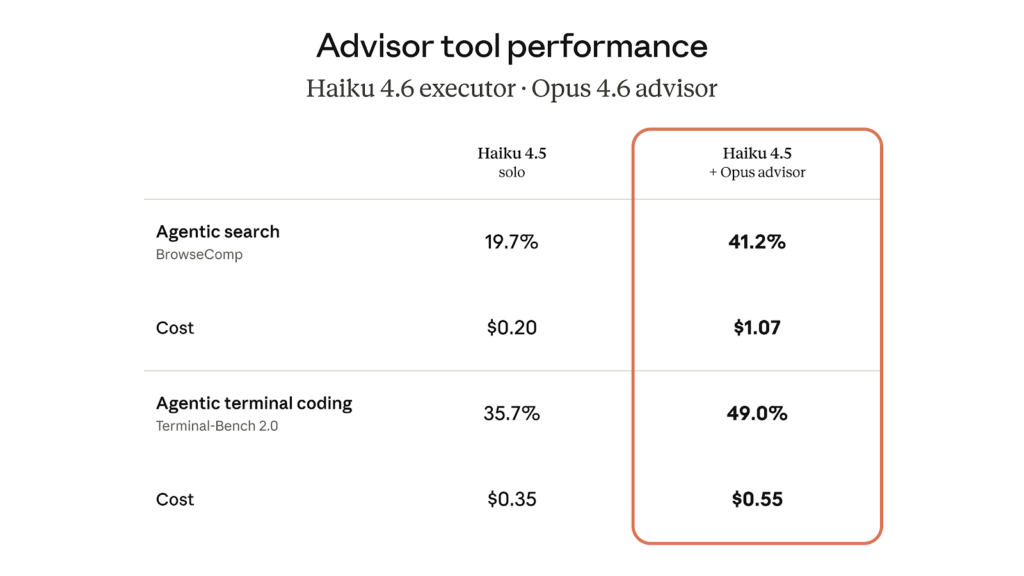
In Claude Code, this is /advisor — or the related /model opus-plan, which runs planning on the stronger model and execution on the cheaper one automatically. The same logic applies to Fable 5: let it plan and make the hard calls, hand the actual typing to Sonnet.
The reverse pattern works tooFable 5’s knowledge cutoff isn’t yesterday, so if a plan needs current information — recent docs, a changelog, competitor pages — that’s not a job that needs Fable-level reasoning, it just needs someone to go and look. Claude Code’s built-in /deep-research workflow fans out web searches across a cheaper model, cross-checks the sources against each other, and hands back one cited report — which you then feed to Fable 5 to actually plan against. Cheap model gathers the facts, expensive model reasons over them. Running that same fan-out research on Fable 5 itself would blow through your usage cap for a step that doesn’t need its reasoning at all.
3. Try pxpipe — turn your context into pictures
This one sounds like a joke and isn’t. pxpipe is a free, open-source local proxy that intercepts requests to Claude Code and converts the bulky, repetitive parts — your system prompt, tool documentation, older conversation history — into PNG images before they’re sent to the model. Claude reads the image back with its vision capability instead of reading it as text.
What it doesn’t touch matters as much as what it does. Your actual current message and everything the model outputs stay as plain text throughout — pxpipe only targets the static, repetitive background context that gets re-sent unchanged on every turn. That distinction is the whole reason this is usable in practice: the parts where getting the answer exactly right matters most (your live question, its live response) are never run through the lossy part at all.
The reason it works: Anthropic prices images by pixel dimensions, not by how much text is packed inside them. Dense content like code or JSON can fit roughly 3 characters per image-token, versus about 1 character per text-token. The developer’s own published numbers: a real session that cost $42.21 running as plain text cost $6.06 through pxpipe — a genuine, documented 59–70% reduction on production workloads.
Two lines to try it:
npx pxpipe-proxy
ANTHROPIC_BASE_URL=http://127.0.0.1:47821 claude
4. Add a “write less” skill
Ponytail is a free Claude Code skill built around one idea: install a “lazy senior developer” mindset that asks, before writing anything, “does this need to exist at all?” It stops agents from over-building — reaching for a library and a wrapper component when a native browser feature would do.
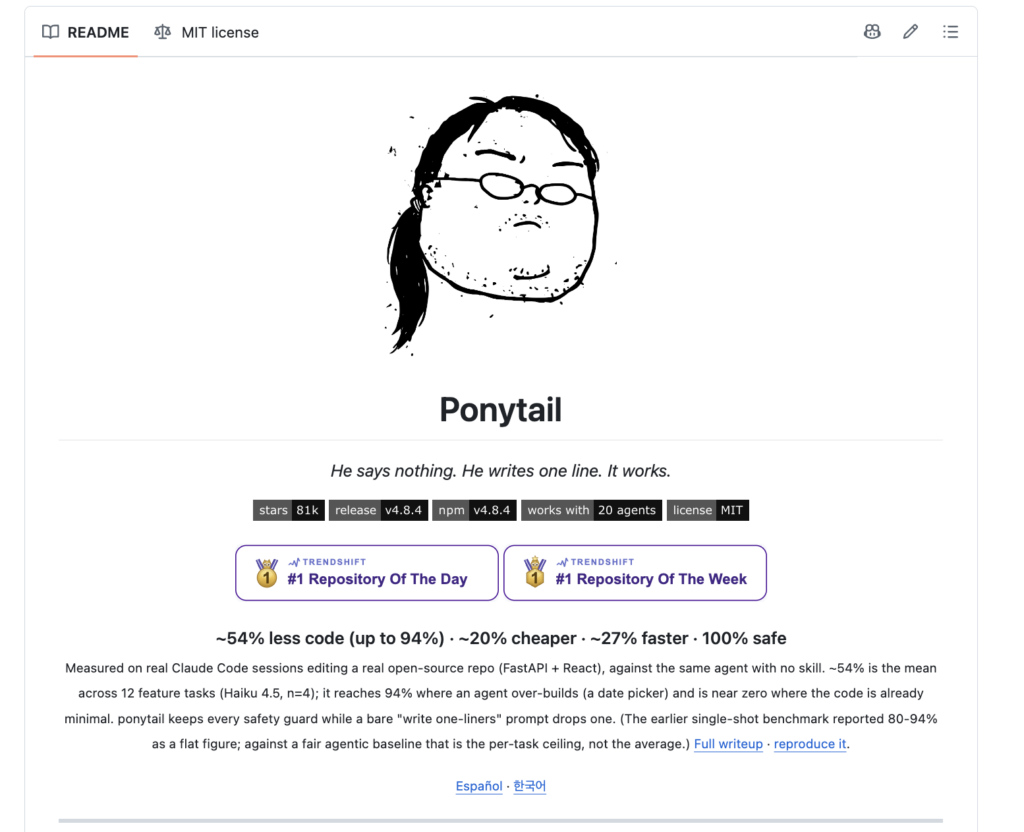
Worth knowing the full story here, because it’s a good lesson in checking numbers rather than trusting a headline: Ponytail’s first published benchmark claimed 80–94% less code. A user pointed out the comparison was unfair — the baseline being compared against wasn’t given the same instructions, so part of the gap was an artifact of that mismatch. The author accepted the criticism and re-ran it properly. The corrected, defensible number: about 54% less code on average, with roughly 20% lower token cost and 27% faster runs, tested on a real FastAPI/React repository, with zero drop in security or error-handling scores. Independent testing on Opus found even better results than the original Haiku-based benchmark.
That’s a more honest number than the first version, and it’s still a real saving. Install it in Claude Code:
/plugin install ponytail@ponytail
5. Clean up what you feed it before you feed it (the save-tokens-in-Claude-Code stack)
This is the boring one and probably the highest-leverage one. A developer running a heavy Claude Code workload every day documented the stack that got him a 60–70% reduction versus running everything raw:
- Compress noisy CLI output before it reaches Claude: A tool like RTK dedupes repeated lines from
greporgit diffoutput — real numbers cited: 76% efficiency on one session. - Ship a curated project snapshot, not the whole repo: Tools like repomix (23k GitHub stars) or code2prompt (7k stars) strip lockfiles, build output, and generated code before Claude ever sees the project.
- Route by task, not by habit: Save the expensive model for planning and genuinely hard problems; let Sonnet handle file-by-file edits. One developer reported this alone cut weekly usage by roughly 40% with no quality drop he could feel.
/compactaggressively, or just start a new session: Long conversations get re-read in full on every turn — token cost grows close to quadratically the longer a session runs.- Write terse prompts for trivial stuff: The so-called “caveman” style — dropping pleasantries and background context for quick lookups — trades some nuance for a real cut in input tokens. Save full sentences for anything touching production.
6. Format is a cost decision, not just a preference
This one’s about what you feed it, not how you run it.
Markdown beats PDF, and it’s not close. A PDF page can cost Claude roughly 1,500–3,000 tokens, because it’s not just reading your content — it’s processing embedded fonts, layout instructions, and rendering noise you never see. The same content saved or converted as plain Markdown can cut that by 65–90%. If you’re regularly uploading reports, contracts, or proposals as PDFs, converting them first (Microsoft’s free, open-source markitdown tool does this in one step) is one of the cheapest wins available.
If you are working with screenshots, crop them. A 1000×1000px image costs roughly 1,334 tokens; a cropped 200×200px region of the same image, showing only what matters, costs about 54 tokens — a 25x difference for the same useful information.
What we’d skip
Not every “hack” making the rounds is worth your time:
- Custom tokeniser tricks: Fragile, save pennies, break with the next model update.
- Prompt-shortening middleware “agents.”: Often add latency and make output worse, not better.
- Switching providers mid-task to save a few cents: The context you lose costs more than what you saved.
A word on timing
Anthropic themselves have said this exploit-the-pricing-gap approach (pxpipe specifically) is unlikely to stay open indefinitely — if enough people lean on it, expect the underlying pricing to move. Treat the specific tricks in this post as a current window, not a permanent floor. The habits — right-sized effort, right model for the job, clean context — are durable regardless of what Anthropic changes next.
Common questions
$10 per million input tokens and $50 per million output tokens — double Claude Opus 4.8’s rate. That’s the highest published rate for any generally available Claude model, which is exactly why the methods in this post matter more once the Claude Fable 5 usage limit resets to standard billing.
Yes, mostly. The advisor pattern, context-cleanup habits, and Ponytail all work across models. pxpipe currently defaults to Fable 5 and GPT-5.6 specifically, though it can be configured for others.
It runs entirely locally before anything reaches Anthropic’s servers, but because it’s lossy for exact strings, avoid using it on anything where a subtly wrong ID or hash would cause a real problem — keep those in plain text.
Further reading in this series:
See more Automation Consulting insights in your search results
Tell Google you’d like more of our thinking, and the next piece turns up where you’re already looking.