Model fatigue is the procurement paralysis that occurs when AI model releases outpace business evaluation cycles. Organisations stall on model selection because a newer version ships before any evaluation is complete. The solution is not a more rigorous evaluation process. It is a deployment decision made against one specific, measurable workflow.
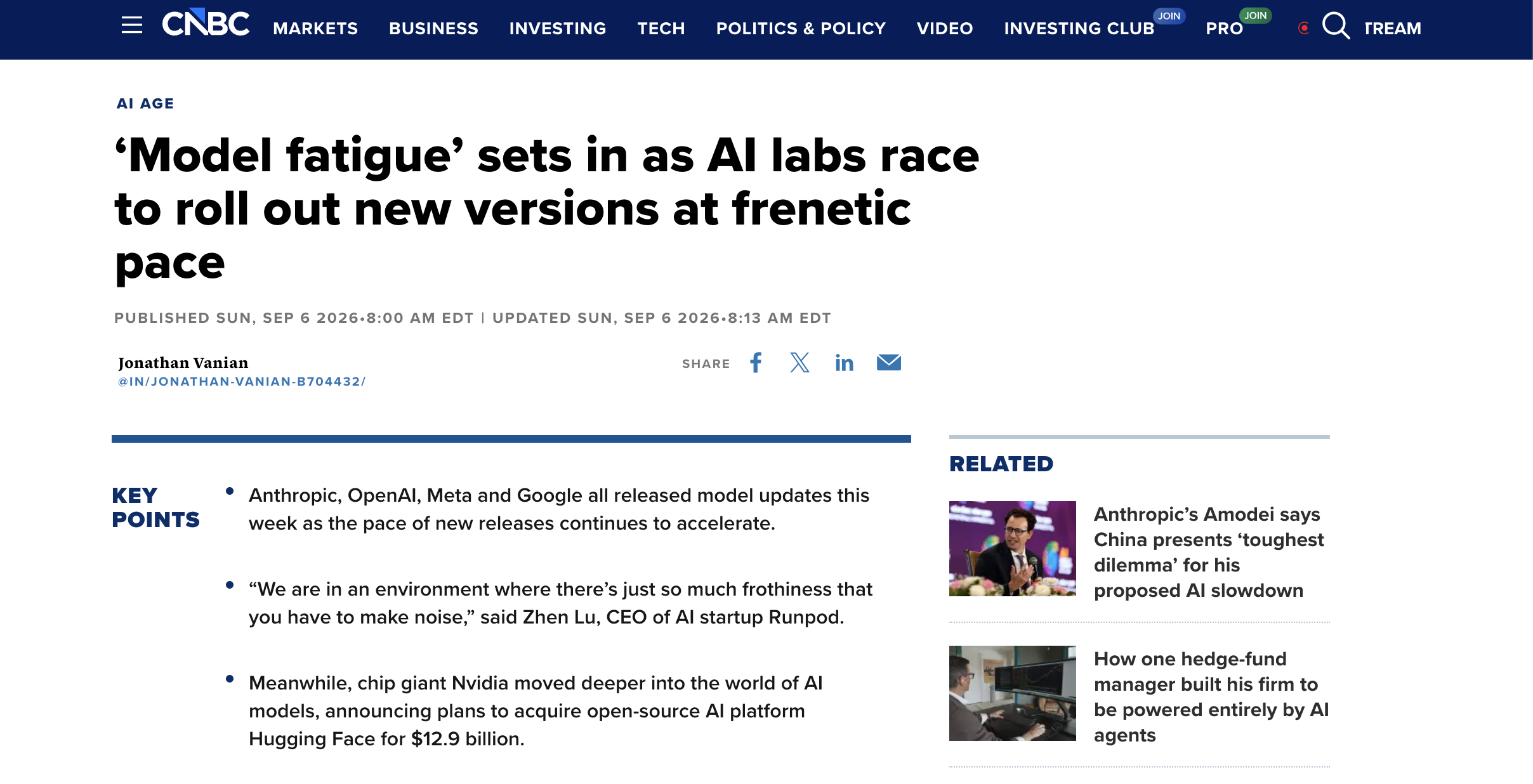
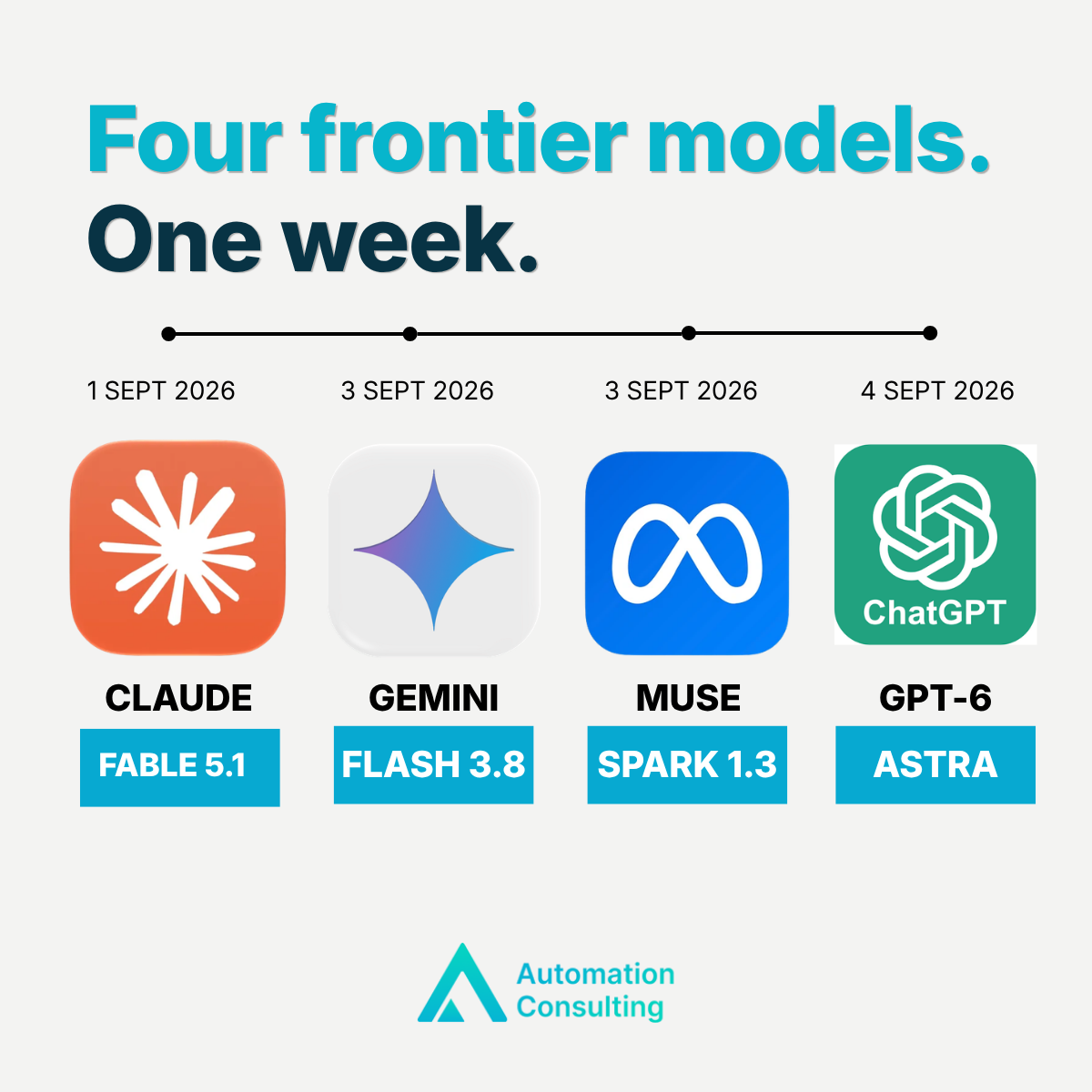
In the first week of September 2026, Anthropic, Google, Meta, and OpenAI each released a new or updated frontier AI model. CNBC reported the result: enterprise AI buyers are experiencing what one AI insider dubbed “model fatigue.” Procurement decisions are stalling. Evaluation cycles are starting on products that change before the review is finished.
This is not a technology problem. It is a decision-making problem, and it has a practical answer.
Why the standard response to model fatigue makes it worse
The standard enterprise response to a fast-moving technology market is more rigorous evaluation. Vendor shortlists. Scoring matrices. Stakeholder review panels. These are capital procurement tools designed for decisions that take years to unwind. AI model subscriptions are not that. They are monthly costs attached to products that ship updates weekly.
Applying enterprise procurement logic to AI model selection does not reduce risk. It transfers the cost of the decision from the vendor to the business. Every week spent in evaluation is a week the current process cost stays on the books. Every comparison meeting produces a recommendation that may be outdated before it is acted on.
The evaluation is the delay. The deployment is the evaluation.
The three questions that replace the evaluation matrix
Most businesses approaching AI model selection are asking the wrong question. “Which model is best?” has no stable answer. The release cadence makes it unanswerable by design.
The right questions are narrower. They are about the specific problem in front of you, not the general state of the market.
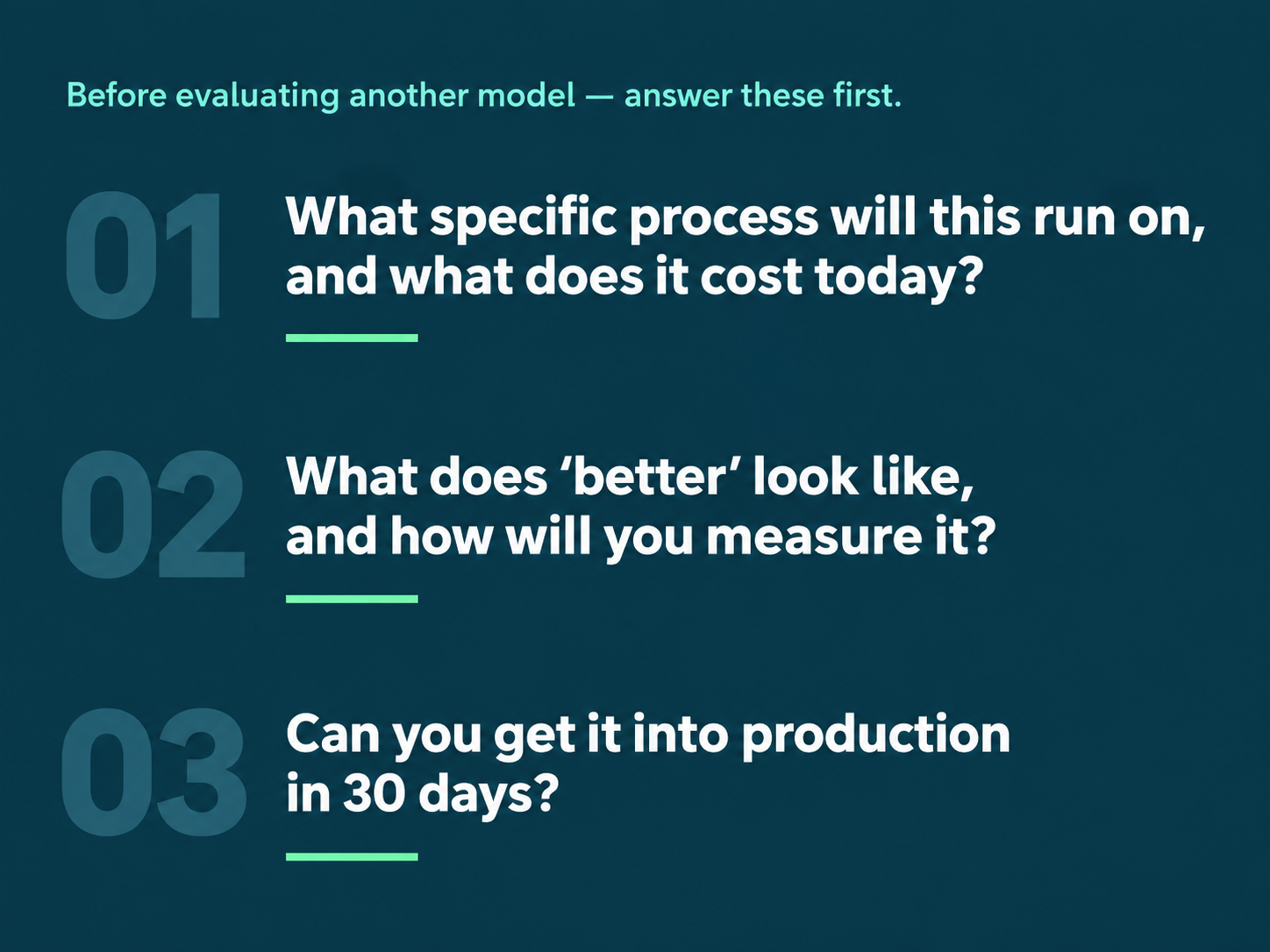
What specific process will this run on, and what does it cost today?
A model deployed against a vague objective produces a vague result. The starting point is a specific, named process with a current baseline. That might be the number of invoices processed per hour, the time taken to review a contract before sign-off, or the volume of support queries resolved without human escalation. If the process cannot be described in one sentence and measured in one number, the model selection decision is premature. Define the process first. Building your first AI agent starts with exactly this step.
What does “better” look like, and how will you measure it?
The organisations that can demonstrate AI ROI share one characteristic: they defined what better looked like before they spent anything. A metric that only exists because AI exists cannot prove that AI worked. The baseline has to predate the deployment. Write down the current number before any model is introduced. Agree on what improvement looks like in concrete terms before the first prompt is written. This is the same measurement problem that breaks business reporting before it reaches any tool.
Can you get it into production in 30 days?
Thirty days is not an arbitrary target. It is the minimum timeframe to generate production data before the next wave of model releases adds noise to the decision. If the answer is no, the blocker is not the model. It is something else: integration complexity, internal approval, data access, or process definition. Those blockers exist regardless of which model is selected. Solve them first.
How to pick a model once you can answer all three
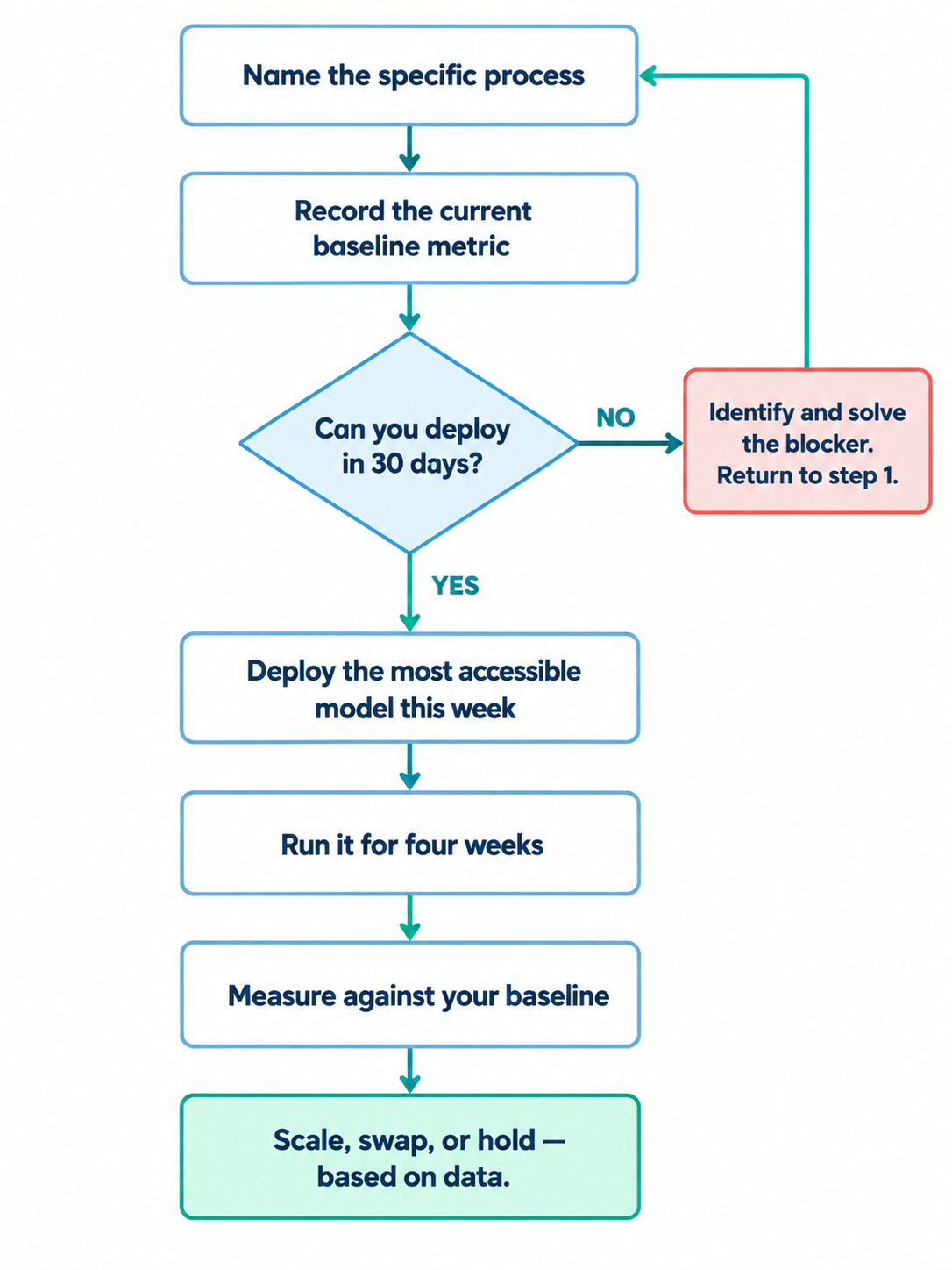
If you have a specific process, a current baseline, and a 30-day deployment path, the model selection criterion becomes narrow. Pick the model your team can deploy against this workflow this week.
Not the model that ranked highest on a benchmark last Tuesday. Not the model a competitor is using. The one with existing API access. The one your team can configure fastest. The one that can go into production before the next release cycle changes the comparison.
Four weeks of a live workflow produces more useful information than any evaluation matrix. After four weeks, you have production data. You can measure actual performance against the baseline you set before deployment. If a better model has shipped by then, the decision to switch is a data decision. You will not have data until something is running.
This is how iteration works in practice. A specific process. A baseline. A deployed model. Four weeks of data. A decision informed by that data. The first deployment will not be optimal. It will be more useful than waiting.
What the release cadence means for Australian businesses
The four-model week in September 2026 is not an anomaly. Multiple major model updates per month across the leading providers is the current state of the industry. It is not expected to slow.
For Australian operations managers, this creates an asymmetry worth noting. Large enterprise procurement teams are the ones stalling. Smaller operators who can define a process on a Monday, deploy a model by Friday, and have four weeks of production data before the next enterprise evaluation meeting has even been scheduled are the ones who will be ahead in twelve months.
The advantage is not technical. It is structural. The window is open now.
Frequently asked questions about AI model fatigue
Model fatigue is the decision paralysis experienced by enterprise AI buyers when the pace of new AI model releases outpaces the time available to evaluate them. The term was used by an AI insider in conversation with CNBC in September 2026 to describe the effect of four major frontier AI model releases in one week from Anthropic, Google, Meta, and OpenAI.
No single model is best for all business contexts. The right model for an Australian small business is the one that can be deployed against a specific, measurable workflow within 30 days using existing access. The selection criterion is deployability against your specific use case, not benchmark performance in a general comparison.
No. The AI model release cadence is not expected to slow. Waiting for a clear winner means waiting indefinitely. The practical approach is to define a specific process, establish a measurable baseline, and deploy the most accessible model that can address it within 30 days.
In 2026, major AI model updates are shipping multiple times per month across the leading providers. Anthropic, Google, Meta, and OpenAI all released new or updated models within the same seven-day window in September 2026.
Switch when production data shows the current model is not meeting the target you defined before deployment. A new release or benchmark result is not a sufficient reason to switch. A metric showing underperformance against your baseline is.
A frontier model is a new architecture or capability class. A point release is an incremental update to an existing model, typically improving speed, cost, or accuracy within the same architecture. Most of the September 2026 releases were point releases. For most business use cases, the distinction matters less than whether the model can be deployed against a specific workflow this week.
Ready to deploy AI on a specific process?
Automation Consulting’s 20 Hours Free offer gives Australian businesses up to $3,000 of pro bono AI and automation work scoped to one specific process, in exchange for a case study. No general AI strategy. One defined problem. Real production data within 30 days.
See more Automation Consulting insights in your search results
Tell Google you’d like more of our thinking, and the next piece turns up where you’re already looking.