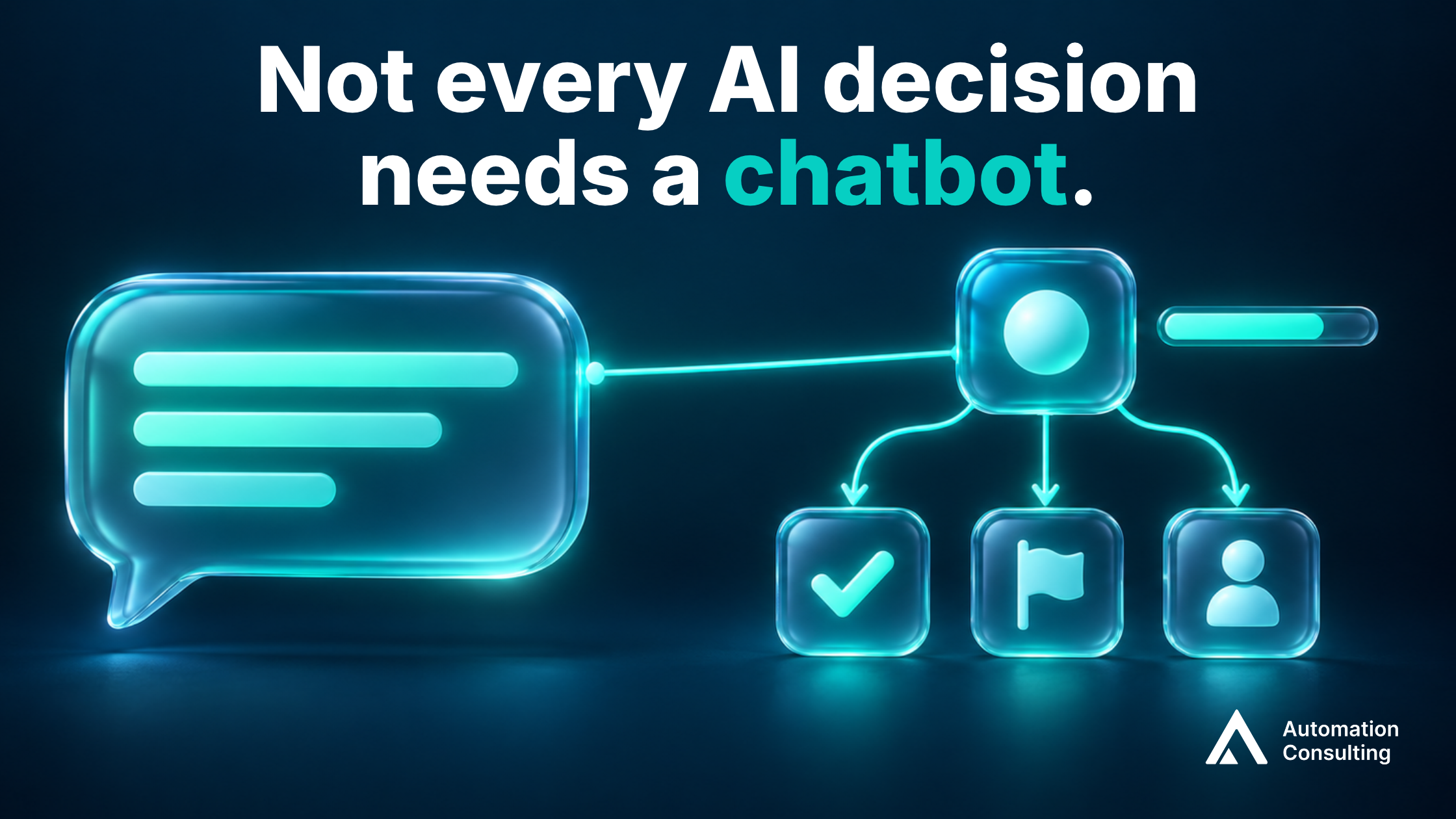
Most businesses only know AI as a chatbot. There is a second category, the decision model, built to make structured decisions for software rather than write answers for people, and most people evaluating AI have never heard of it. If you are building an AI agent, that gap matters, because a well-built agent uses both kinds.
Why most people have only seen half the picture
Every AI model most businesses have used, ChatGPT, Claude, Gemini, works the same way: you ask a question and get a written answer back. That is what most people mean by “AI model”, and it is only half of what exists.
An AI agent is a workflow, not a conversation. Most of the decisions inside that workflow were never meant to be read by a person. Is this transaction worth flagging? Which queue does this ticket belong in? Does this application clear the bar? A model built to write paragraphs can answer all three, but it is the wrong tool for the job, slower and more expensive than the decision needs.
| Feature | Text model (ChatGPT, Claude, Gemini) | Decision model (Jev) |
|---|---|---|
| What it returns | Written text: answers, summaries, code | A typed answer (a choice, a score or true/false) with a probability, plus a confidence level on choices and scores |
| Who or what reads it | A person | Your software |
| Best for | Drafting, explaining, conversation, anything a person reads or approves | Classifying, routing, scoring and checking at high volume |
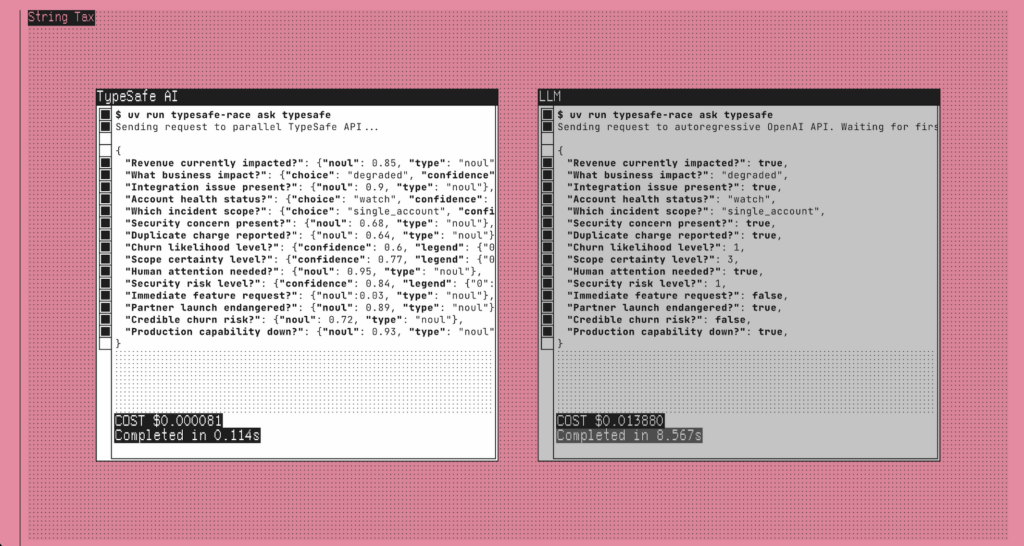
| Speed | Seconds or longer per response | 70 to 500 milliseconds (TypeSafe’s published range for Jev) |
| Cost | Priced per token on input and output | Jev: $0.042 per million input tokens, output free (TypeSafe’s published pricing) |
| Main risk | Can state wrong things fluently | Can pick the wrong option, sometimes with high confidence |
| Human fallback | Usually, for anything that matters | Yes, for low-confidence cases |
How a decision model works
A decision model takes two things: a block of information about the situation, and a set of narrow questions about it. It does not write a reply. For each question it returns a structured answer and the probability behind it. Choice and score questions also return a confidence level. Your own software decides what happens next.
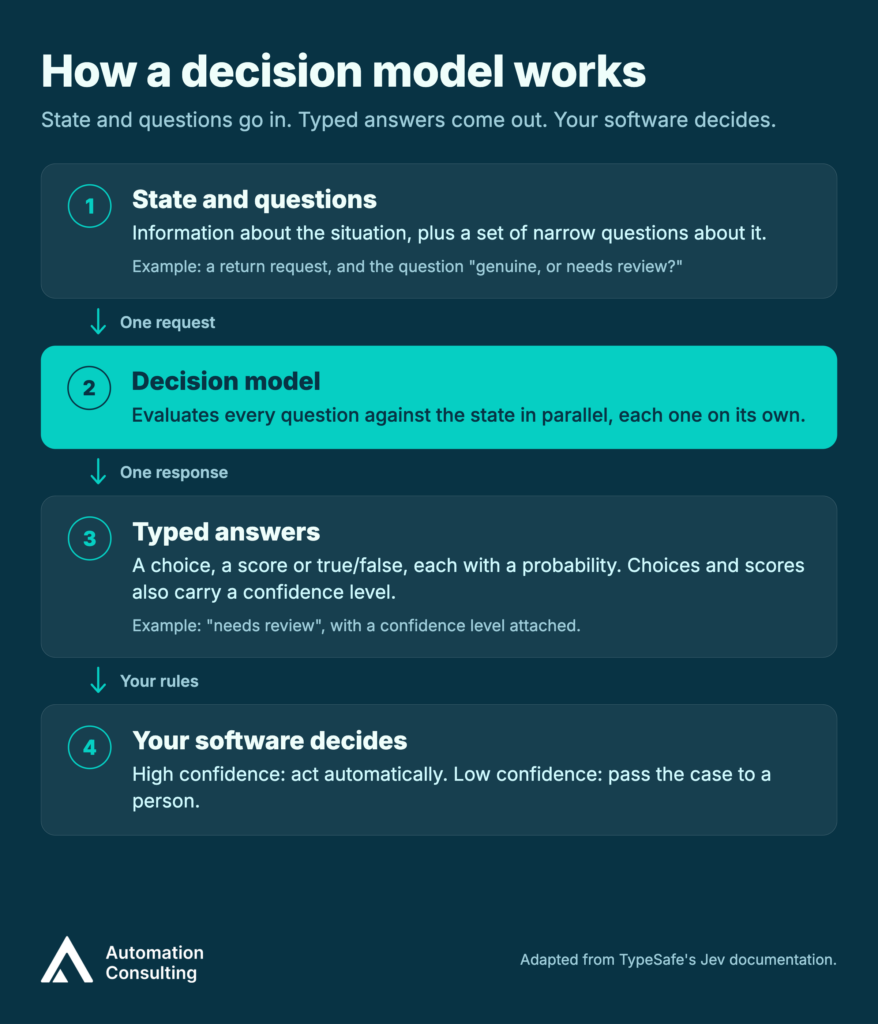
The questions come in a few simple types: pick one option from a list, score something against a rubric, or check whether a statement is true. Each question is evaluated separately, so you can ask several at once and combine the answers with ordinary logic. If confidence is high, the workflow acts automatically. If it is low, the case goes to a person.
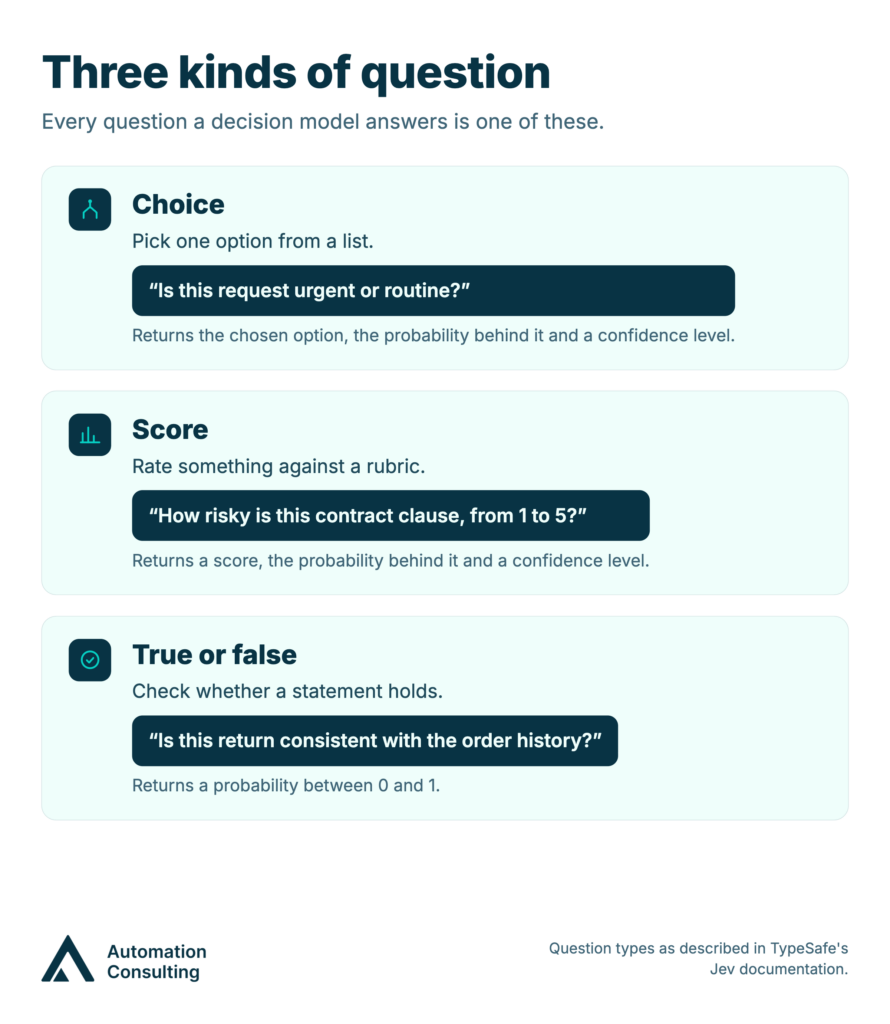
That last step matters most. The model’s job is not to be right every time. It is to tell your software how sure it is, so the software knows when to ask for help.
A real example of a decision model: Jev
In September 2026, TypeSafe AI released Jev, which it calls the first “System One” model, a nod to the fast, intuitive thinking Daniel Kahneman described. Jev does not generate text. TypeSafe describes it as a function call powered by AI: information goes in, typed decisions come out, in 70 to 500 milliseconds. Input costs $0.042 per million tokens and output is free. TypeSafe describes Jev as being in early access, and independent testers have been running it through providers such as OpenRouter.
Be careful with the headline numbers. TypeSafe claims Jev is 193.6 times faster and 444.6 times cheaper than standard models on its own workflow tests, and the company itself says those figures are on the higher end of real-world gains. Independent testers have since published their own results, and they agree on speed and cost more than on accuracy. In one independent email-classification test, Jev cost 12 to 27 times less than Claude Haiku 4.5. In a legal benchmark run by Vals AI, it finished last of twelve systems on raw accuracy, while tying the best systems on claim verification. The accuracy depends on the task. We cover what holds up and what does not in a separate piece.
Where a decision model fits in an AI agent
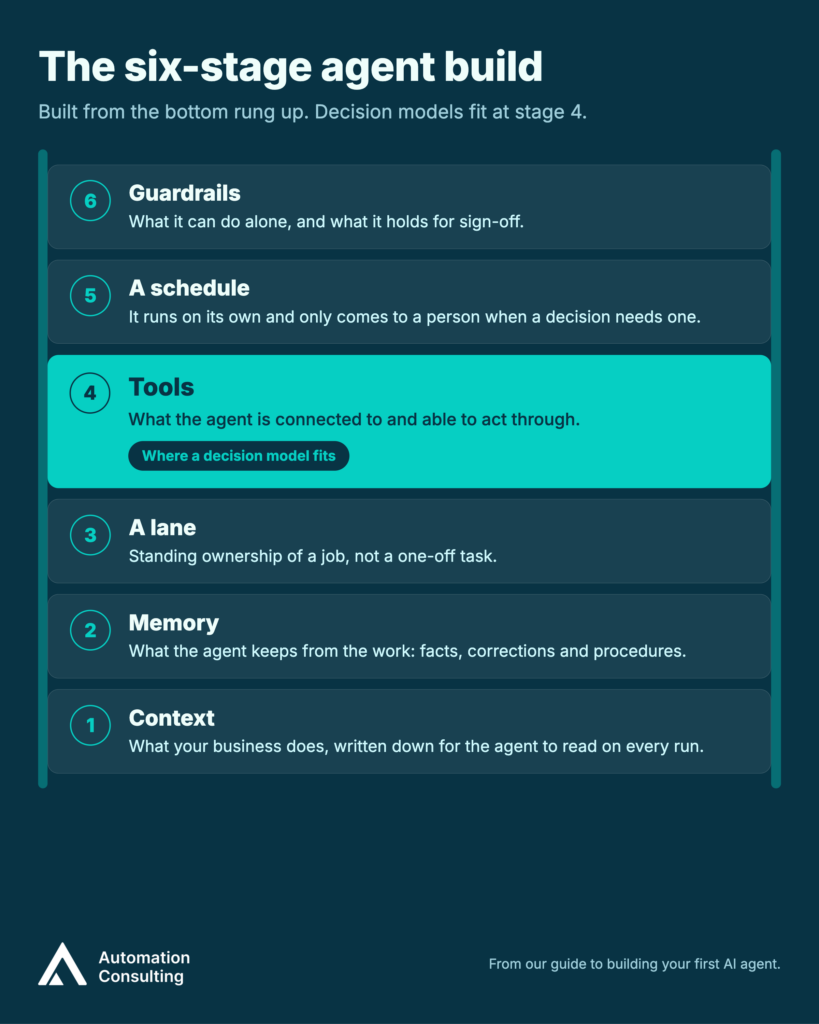
In the six-stage build in our guide to building your first AI agent, this sits in the tools stage: what the agent is connected to and able to act through. A well-built agent does not send every decision through one kind of model. A text model handles anything a person needs to read or approve. A decision model handles the high-volume calls that need an answer, not a paragraph.
Two practical points before you build
First, ask small questions. Decision models work best on narrow, gut-check judgements, so split a complex call into several simple questions and combine the answers in your own logic. In the same email test, accuracy jumped when one broad question was split into five narrower ones and the answers were combined by a simple classifier trained on labelled examples. Second, treat the confidence score as something to test. “Cannot hallucinate” means the model cannot return an answer outside the options you defined. It can still choose the wrong option, so thresholds and a human fallback matter, and the scores should be checked against your own data before you trust them.
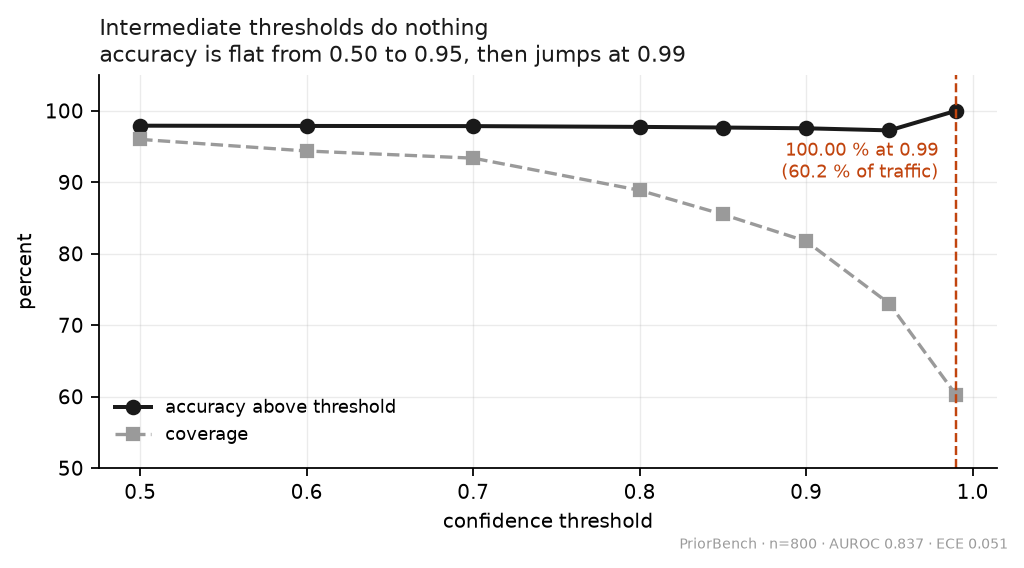
In one independent evaluation, accuracy barely moved as the confidence threshold rose from 0.5 to 0.95, and only reached 100% at 0.99, where 60.2% of cases still qualified. In that test, a threshold that looked sensible did nothing until it was very high.
Before you automate any decision, record how long it takes and what it costs today, the same baseline-first approach we cover in how to measure AI ROI.
Choosing between competing text models is a separate decision, which we cover in our piece on AI model fatigue.
Where Australian businesses can use a decision model
Four places the same pattern shows up, one for each sector we work in, with the evidence behind each.
| Sector | The decision | Example question | Why it is worth a look |
|---|---|---|---|
| Retail | Return, or return fraud | “Given item condition, return history and time since purchase, does this look genuine or need review?” | A Griffith University-led survey of 5,900 online shoppers in Australia, the US, the UK and Canada found 17% admitted to return misconduct in the past year. The report recommends risk scoring to send high-risk returns to a second person for review. |
| Fintech | Flag a transaction | “Given amount, location and account history, is this likely fraudulent?” | Australians reported more than $2 billion in scam losses in 2025, according to the National Anti-Scam Centre’s Targeting Scams report. Spotting a suspect transaction quickly is the kind of narrow, high-volume call a decision model is built for. |
| Real estate | Triage a maintenance request | “Given the description and property type, is this urgent or routine?” | Almost 70% of Australian property service businesses use AI, ahead of finance and insurance (64%) and business services (61%), according to NAB’s 2026 SME survey. |
| Professional services | Review, or proceed | “Given this contract’s terms and our standard playbook, does this need partner review, or can it proceed as is?” | Business services is one of the most AI-active sectors in Australia, at 61% of SMEs (NAB, 2026). Contract and proposal generation is among the most widely adopted AI tasks in a PYMNTS Intelligence study of wholesale firms. That is drafting. This is the review decision that follows. |
Picture a Melbourne insurance broker handling property claims (an illustrative scenario, not a client case). A claim comes in and someone has to make a fast call: does it look straightforward enough to fast-track, or does it need a loss adjuster on site? Today that first read often falls to whoever is free. A decision model in that step can make the same fast-track-or-flag call in seconds, using the same criteria every time, and leave the adjuster’s time for the claims that need a person.
A few things worth knowing
Public attention has gone almost entirely to chatbots and text generation, because that is what people interact with directly. Decision models work behind the scenes inside software, so there has been no equivalent public moment, until releases like Jev made the category visible.
No. Most working agent setups use both: a text model for anything a person reads or signs off, a decision model for the high-volume decisions that do not need explaining.
Related but different. Our piece on AI model fatigue is about choosing between competing text-generating models. This is about recognising that some decisions in a workflow do not need a text model at all.
Look for a step where someone reads something quickly and makes a consistent call: approve or flag, route A or B, urgent or not. If the rule behind that call could be written down, it is a candidate.
An insurance broker’s fast-track-or-flag call on property claims is one example: a decision currently made by whoever is free, which a decision model can make in seconds and consistently, leaving the adjuster’s time for claims that need a person.
Yes. It cannot return an answer outside the options you define, but it can pick the wrong option, sometimes with high confidence. Treat the confidence score as a signal to test against your own data, keep a human fallback for low-confidence cases, and run it alongside your current process before it acts on its own.
See more Automation Consulting insights in your search results
Tell Google you’d like more of our thinking, and the next piece turns up where you’re already looking.