Australian homes and small businesses now have rooftop solar, an installed base that keeps pulling through inverters, batteries and switchgear long after the original sale
Electrical & Renewable Equipment Distributors
Whether you’re an electrical wholesaler, solar and battery distributor, importer or renewable equipment supplier, we connect and automate the systems your business runs on so you can take on more products, customers and orders without taking on more admin.
The Aussie automation partner rated








The Industry Landscape
Australian demand keeps growing, and every unit of it moves through distribution
Whether it’s rooftop solar, home batteries, EV charging or the electrical work going into new construction and industry, the volume keeps rising. Every panel, inverter, battery, charger and reel of cable behind these numbers is a supplier price change, a SKU to keep straight, a unit to stock and an order someone has to get right.
home batteries went in during the first year of the federal battery rebate, 12.4 GWh of storage that had to be sourced, stocked, shipped and supported
public EV charging connectors are now in the ground across 4,268 locations, a product category that barely existed in most catalogues a few years ago
of rooftop solar was installed in the first half of 2026, a record half year. Behind that number sit supplier price files, product data, stock allocation and thousands of orders that someone had to process
Our Perspective
Distribution gets harder as you grow
Growth in electrical and renewable equipment distribution creates a particular kind of complexity.
More product lines mean more supplier data to manage. More customers mean more contract pricing, account terms and quotes. More branches and warehouses make stock harder to see. Ecommerce, trade counters, sales teams and customer portals all need accurate information from the same underlying systems.
Before long, the business can be running across an ERP, warehouse systems, ecommerce, spreadsheets, supplier feeds and applications that were never designed to work together.
That’s where the operational drag starts.
Your people spend time updating the same information in multiple places. Supplier price changes need manual handling. Stock looks different depending on which system you check. Orders require intervention before they can be fulfilled. Product data has to be cleaned before it reaches the website. Customer service teams chase information that should already be available.
We help fix the systems underneath it.
Built For The Sector
Technology built around how electrical distribution actually works
Electrical and renewable distribution isn’t generic wholesale.
You may be managing thousands of SKUs, multiple suppliers for the same product category, customer-specific pricing, large project quotes, rebates, multiple units of measure and stock spread across branches or warehouses.
Solar, batteries, inverters, switchgear, lighting, cable, EV charging equipment and electrical accessories bring their own product data, availability and technical information requirements.
The technology has to support the way the business actually buys, stocks, prices, sells and fulfils those products.
Product and catalogue data
Keep product information consistent between suppliers, your ERP, PIM, ecommerce platform, sales teams and customers. We can help automate supplier catalogue updates, clean and structure product data, map supplier SKUs to your internal records and create one reliable source for product information.
Pricing, margin and rebates
Customer-specific pricing, project pricing, trade discounts, supplier price changes and rebates quickly become difficult to manage when the information lives across different systems. We connect the underlying data and automate the workflows around pricing updates, approvals, margin checks and reporting so commercial teams have better control over what is being bought and sold.
Inventory and warehouse visibility
Give sales, purchasing, warehouse and customer service teams a clearer view of what is in stock, committed, on order or available at another location. That can include ERP and WMS integration, replenishment workflows, branch transfers, barcode or scanning workflows, purchasing automation and real-time stock availability across sales channels.
Orders and fulfilment
Reduce the manual work between an order being placed and the product reaching the customer. We connect ecommerce, trade portals, EDI, ERP, warehousing, freight and finance systems so order information can move through the business without being repeatedly entered, checked and reconciled by staff.
Customer and trade experiences
Make it easier for trade customers to do business with you. We design and build ecommerce experiences, customer portals and account tools that can surface the information customers actually need: their pricing, stock availability, orders, invoices, product information and account history.
Suppliers and purchasing
Connect supplier information more directly into purchasing and operations. From supplier price files and purchase orders through to stock receipts, product updates and invoice processing, we automate the repetitive work between your suppliers and internal systems.
One Connected Operating Environment
Your ERP shouldn’t have to do everything. But everything should work together.
Many distributors already have systems that work well in parts of the business.
The problem is often what happens between them.
Your ERP may handle finance and inventory. Your ecommerce platform manages online orders. Your warehouse has its own processes. Suppliers send price files and product information in different formats. Salespeople work in CRM. Customers expect self-service. Finance needs accurate data at the end of it all.
Replacing every platform isn’t always the answer.
ERP
Sales, purchasing, inventory, finance and core business operations.
PIM & product data
Product attributes, specifications, images, supplier information and catalogue management.
Warehouse & inventory systems
Stock movements, receiving, picking, replenishment and multi-location visibility.
Ecommerce & trade portals
Online ordering, account pricing, availability and self-service.
CRM
Customer relationships, opportunities, account information and sales activity.
EDI & supplier systems
Purchase orders, invoices, product information and transaction exchange.
Freight & logistics
Carrier integration, dispatch, tracking and delivery workflows.
Reporting & data
A consistent view across sales, margin, stock, purchasing and customer activity.
We work out what should stay, what should improve, what needs to connect and where a new system is genuinely required.
Our Solutions
What we can do for electrical and renewable equipment distributors
Built to remove friction where it actually lives: across systems, approvals, reporting, and the handoffs your team currently carries manually.


ERP consulting and modernisation
Your ERP sits at the centre of the business, but growth can expose processes that no longer fit. We help assess, improve, integrate or replace ERP environments across inventory, purchasing, order management, finance and distribution operations. We aren’t tied to forcing one platform into every business: we start with the operating problem and determine what technology makes sense around it.
- ERP assessment and roadmap
- ERP implementation and optimisation
- Legacy system modernisation
- Multi-branch and multi-entity workflows
- Inventory and purchasing processes
- Finance and reporting integration
- Data migration
- Custom ERP extensions
Systems integration
Connect the platforms your teams already depend on. We build integrations between ERP, ecommerce, CRM, WMS, accounting, suppliers, freight carriers and custom applications so information moves through the business automatically. That means less copying between systems, fewer reconciliation problems and a more reliable flow from supplier through to customer.
- ERP ↔ ecommerce
- ERP ↔ WMS
- ERP ↔ CRM
- ERP ↔ PIM
- Supplier ↔ purchasing
- EDI ↔ ERP
- Freight ↔ fulfilment
- Finance ↔ operational systems
Product data and PIM
Product data becomes an operational problem long before it becomes a marketing problem. Different supplier formats, duplicate records, missing attributes, changing specifications and inconsistent product descriptions can create work everywhere from purchasing to ecommerce. We help create the processes and systems that turn supplier information into structured, reliable product data your business can use across every channel.
Product DataEcommerce and trade portals
Trade customers expect more than a public product catalogue. They want their pricing. Their account. Their previous orders. Accurate availability. Easy repeat ordering. Access to invoices and documentation. We design and build B2B ecommerce and self-service experiences that connect directly to the systems running the business instead of creating another disconnected layer.
Trade PortalWorkflow and process automation
Not every problem needs a new system. Sometimes the biggest gains come from removing the manual work between existing ones. We automate repetitive processes across:
- Supplier price updates
- Purchase order processing
- Sales order entry
- Order confirmations
- Inventory updates
- Invoice processing
- Approvals
- Returns and warranty workflows
- Customer notifications
- Data reconciliation
- Reporting
- Product information management
Custom software development
When your operating model has requirements that off-the-shelf software doesn’t handle well, we build the missing layer. That might be an internal operations application, pricing tool, customer portal, workflow engine, supplier interface or a custom application connecting several existing platforms. The goal isn’t custom software for its own sake. It’s solving the process your existing stack can’t.
Custom BuildAI where it actually makes sense
AI should solve a business problem, not become another system your team has to manage. For distributors, useful applications can include extracting information from supplier documents, enriching product data, answering product and account questions, processing inbound requests, identifying exceptions and helping staff find information across large catalogues and internal systems. We combine AI with workflow automation and your existing business systems so it can actually complete useful work rather than simply generate an answer.
Applied AINot sure where to start? Tell us which part is hurting most, the supplier price files or the order flow, and we will map the fastest fix.
Discuss your project
Where We Look First
Where we typically find the opportunity
Supplier price files still require hours of manual work
Different suppliers send thousands of price changes in different formats. Staff have to match products, update costs, check sell prices and make sure margins haven’t moved unexpectedly.
We can build a controlled workflow to import, match, validate and apply supplier pricing changes.
Nobody fully trusts the stock number
Your ERP says one thing. The warehouse says another. Ecommerce shows something different again. Committed stock, incoming purchase orders, branch transfers and online availability may all be calculated differently.
We can connect the relevant systems and create a more reliable view of inventory across the business.
Customer pricing has become difficult to manage
Trade pricing, customer-specific discounts, project rates and exceptions accumulate as the business grows.
We can simplify the data model and workflows behind pricing, approvals and margin visibility.
The same order gets handled several times
An order enters through email, ecommerce, EDI, a salesperson or the trade counter, then gets re-entered or checked manually before fulfilment.
We can automate the flow between ordering, ERP, inventory, warehouse, freight and finance.
Your ecommerce site is disconnected from the real business
Customers can browse products online, but pricing, availability, account information or orders don’t reliably reflect what’s happening in the ERP.
We can make ecommerce part of the operating environment rather than a separate storefront.
Reporting still depends on spreadsheets
Finance, purchasing, operations and sales export their own versions of the data and spend time reconciling them before anyone can make a decision.
We can connect operational data and automate reporting around stock, sales, margin, purchasing and customer activity.
Who We Work With
Built for the businesses supplying Australia’s electrification
We work best with established distribution businesses where operational complexity has outgrown the way the systems were originally put together.
That includes:
Electrical wholesalers
Businesses supplying electrical contractors, builders, infrastructure projects and industrial customers across trade counters, branches, sales teams and digital channels.
Solar and battery distributors
Distributors managing panels, inverters, batteries, mounting systems, electrical components and associated renewable products.
Electrical equipment importers and distributors
Businesses bringing equipment into Australia and managing supplier relationships, product data, inventory, compliance information, warehousing and downstream distribution.
EV charging equipment distributors
Businesses supplying charging hardware and associated electrical equipment through installer, contractor and commercial channels.
Multi-branch equipment suppliers
Distribution groups where stock, customer accounts, pricing and purchasing need to work consistently across multiple locations or entities.
Platforms
We work with the platforms your business already runs on
We implement an ERP where one is genuinely the right answer, and connect and automate what you already run where it is not. These are the platforms we work with most often across distribution.













Why Us
Why Automation Consulting
We start with the business process, not the software
A technology project shouldn’t begin with a predetermined platform. We first understand how products, information and orders actually move through your business. Then we determine where the constraint sits and what should change.
Sometimes that’s a new ERP. Sometimes it’s an integration. Sometimes it’s fixing product data. Sometimes it’s automating three manual steps between systems you should keep.
We work across the stack
Distribution problems rarely stop at the boundary of one application. Our work spans AI and automation, ERP, systems integration, ecommerce and custom software, which means we can address the whole operating flow rather than optimising one system while leaving the hand-offs untouched.
We build, not just advise
We can go from mapping the problem and designing the architecture through to integrations, applications, automation and implementation. That keeps strategy tied to what can actually be delivered.
We are platform-agnostic
We don’t need your answer to be a particular ERP, automation platform or AI model. We’ll work with the systems worth keeping and recommend changes where the business case justifies them.
We focus on measurable outcomes
The point isn’t to implement more technology. It’s to improve the economics of the operation: more orders handled, fewer manual touches, better stock visibility, faster customer response, stronger margin control or more capacity without equivalent growth in administrative overhead.
How We Work
How we approach your systems
-
Understand the operation
We map how products, pricing, purchasing, stock, orders, customers and finance move through your business today.
-
Find the constraints
We identify the manual work, system gaps, duplicated data and bottlenecks actually limiting capacity or creating risk.
-
Decide what should change
Keep what works. Connect what’s disconnected. Automate what’s repetitive. Replace what genuinely needs replacing.
-
Build and integrate
Our team implements the integrations, workflows, platforms or custom software required.
-
Improve from there
Once the foundation works, we can continue improving processes, adding functionality and applying automation or AI where the economics make sense.
Explore Related Capabilities

ERP Consulting Services
ERP scoped, configured and implemented by the team that does the building, not a report and a hand-off.

Custom Software Development Services
Systems integration and purpose-built applications for the processes your existing stack can’t carry.

Workflow Automation Services
We automate the manual work inside your business and keep it running 24/7, without adding headcount.

AI Automation Services
AI put to work inside real workflows, so it completes the task rather than just answering about it.

E-Commerce Development
B2B storefronts and trade portals built onto the systems that actually hold your pricing and stock.

Digital Transformation Services
Strategy through execution, with systems modernised, data connected and work automated.

Customer Service Automation
AI chatbots and helpdesk automation that resolve enquiries and turn visitors into booked leads.

IT Consulting Services
Independent advice on the technology decisions that are expensive to get wrong. We resell nothing.
Your next system probably doesn’t need to start with a system replacement
If your electrical or renewable distribution business is growing but your operational systems aren’t keeping up, start with the bottleneck. We’ll look at how your products, stock, pricing, orders, suppliers and customers move through the business and identify where technology can create the clearest return.
Or claim 20 hours of automation consulting, free, before you commit.
The leadership behind the work

Fabrice Jiew
Founder & CEOWho your leadership team deals with — accountable from first conversation to go-live.

Bac Dam
Co-founder & CTOOwns the build decisions — systems that hold up in production and run 24/7.

Michael Zajer
Delivery ManagerYour single point of contact while we build — owns scope, timelines, and comms.

Hebe Nguyen
Automation Strategy ConsultantMaps your processes and finds the automations worth building — before anything gets built.
Let us help you
Tell us what’s slowing you down
We’ll respond within 30 minutes and help you identify where automation could create the most value.
- Identify the workflows worth automating first
- Pinpoint the quickest payback
- Agree a clear next step
- 100% Client return rate
- 5.0 Rated on Google
- $2M+ Delivered project value
What clients say
Hear it straight from
Hear it straight from
the leaders we work with
Since going live we’ve cut admin time by over 60%, reduced stock issues, sped up reporting, and improved guest response times. It paid for itself quicker than expected.

Their ability to translate complex AI concepts into clear, actionable strategies tailored to each client’s needs is exceptional. Their consulting approach is both strategic and hands-on.

They took the time to understand how we operate, pinpointed areas that needed tightening up, and implemented practical solutions that have genuinely improved our turnaround times and overall clarity.

Automation Consulting has been excellent to work with. Their team demonstrates strong expertise, clear communication, and a commitment to delivering value. Highly recommended!

Quick Q&A
Frequently asked questions
Electrical wholesalers commonly use a combination of ERP, inventory or warehouse management systems, ecommerce, CRM, accounting, supplier integrations, EDI, freight systems and reporting tools. Larger and multi-branch distributors may also use product information management systems, trade portals and custom applications.
The challenge is often less about having the individual systems and more about making data move reliably between them.
Common opportunities include supplier price-file processing, product-data updates, purchase order workflows, sales order entry, inventory updates, customer notifications, invoice processing, returns, warranty workflows, reporting and data synchronisation between ERP, ecommerce, warehouse and CRM systems.
The right automation depends on where staff are currently doing repetitive work or moving information between systems manually.
ERP software connects core processes such as purchasing, inventory, sales orders, customer accounts, finance and reporting.
For electrical wholesalers, the ERP also needs to accommodate requirements such as large product catalogues, customer-specific pricing, supplier price changes, rebates, multiple branches or warehouses and integration with trade and ecommerce channels.
Not necessarily.
If your existing ERP still handles its core responsibilities well, the better option may be to integrate it with ecommerce, warehouse, CRM, supplier or customer systems and automate the workflows between them.
We assess what should stay, what can be improved and what genuinely needs replacing before recommending a technology approach.
Yes. Systems integration is a major part of our work.
Depending on your existing technology, this can include synchronising products, pricing, customers, sales orders, stock availability, fulfilment status, invoices and other operational information between ERP, ecommerce, warehouse and surrounding systems.
AI is most useful where the business deals with large volumes of unstructured information or requests.
Potential uses include extracting information from supplier files and documents, product-data enrichment, internal product search, customer service, inbound email processing, document classification and identifying exceptions that need staff attention.
For predictable rules-based processes, standard workflow automation is often simpler and more cost-effective than AI.
Yes.
Our approach is platform-agnostic. We can work around existing ERP, ecommerce, CRM, warehouse, accounting and other business systems where they remain suitable.
The objective is not to replace technology unnecessarily. It’s to build an operating environment that works as one connected system.
We are best suited to established electrical wholesalers, renewable equipment distributors, solar and battery distributors, importers and multi-branch equipment suppliers dealing with growing operational complexity.
Typical triggers include rising order volume, large product catalogues, multiple warehouses or branches, disconnected systems, excessive spreadsheet use, customer-specific pricing or increasing manual administration.
Still have questions?
Reach out
How we think
From insight to implementation
All insights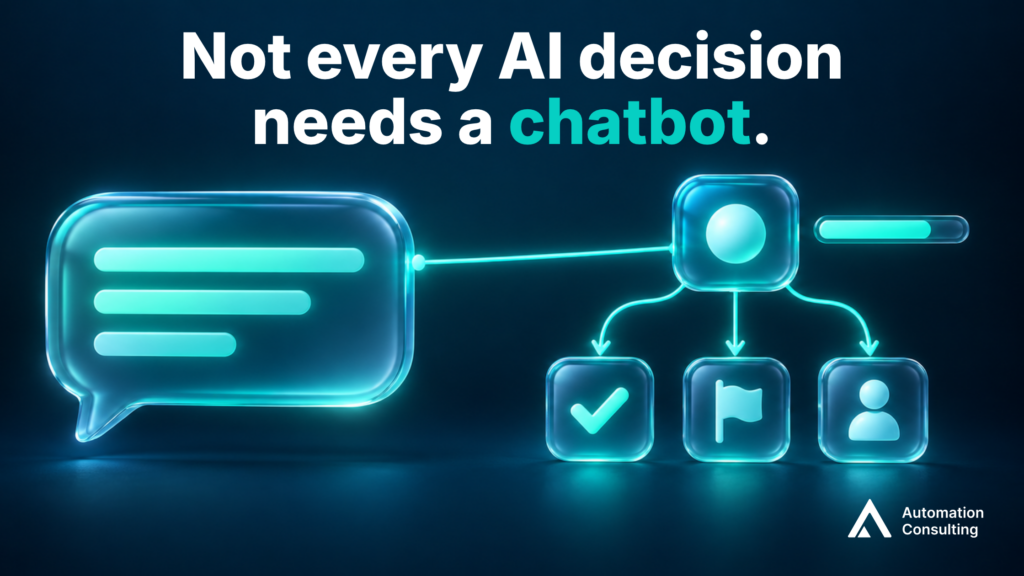
AI Agents Don’t Just Need Chatbots. Some Need a Different Kind of Model Entirely.
Most businesses only know AI as a chatbot. There is a second category, the decision model, built to make structured...
AI Automation Services Guide: Types, Examples, Trends & ROI (2026)
6 Best AI Automation Companies in Australia 2026: An Honest Buyer’s Guide