Why the tool is rarely the problem
When a business reporting system is slow or inaccurate, the instinct is to look at the software. A better dashboard. A faster query engine. Or a new vendor.
In most cases, the tool is not where the failure happens.
Most reporting systems require a business user to convert a question into a structured request. That request is then passed to someone with technical access. From there, a report is built and interpreted before an answer comes back. That sequence is the translation layer. Every step introduces delay. Every step is a place the original question gets distorted.
By the time an answer lands, the decision it was meant to inform may already have been made. Or the context has changed.
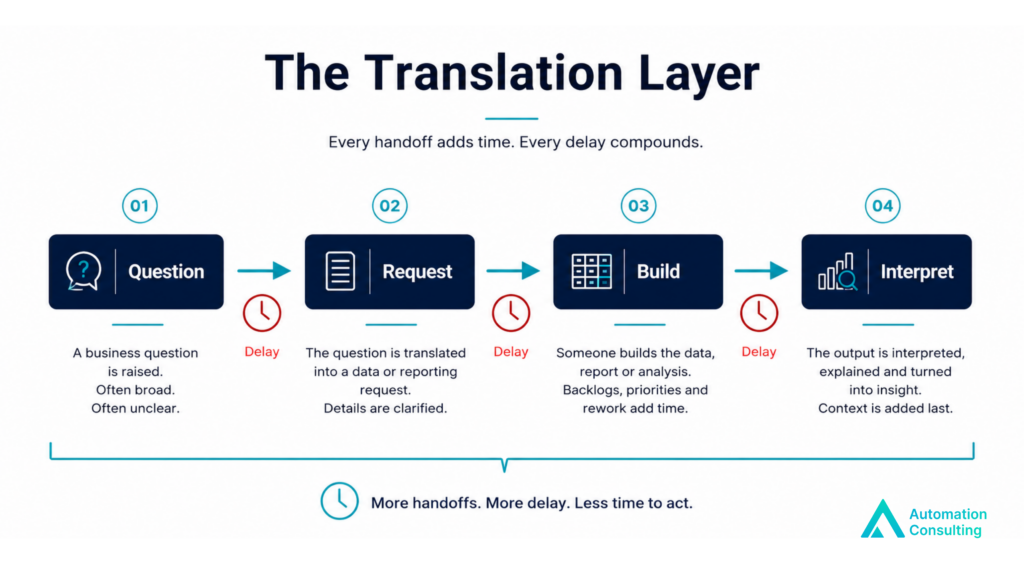
The four steps where business reporting breaks down
The question step
A business user has a question but cannot query the data directly. The question gets written down, described in a meeting, or sent via email. As a result, precision starts eroding immediately.
The request step
A data analyst interprets the question and translates it into a query. However, their interpretation is not always what was meant.
The build step
A report is built against the query. This takes time. In many organisations, it spans days. The business user cannot see work in progress or course-correct.
The interpretation step
Once the report lands, if the answer is unexpected, it is not clear whether the data is wrong or the assumption was. As a result, a second round of requests begins.
No faster or more expensive BI tool addresses these failure points. Only removing the translation layer does.
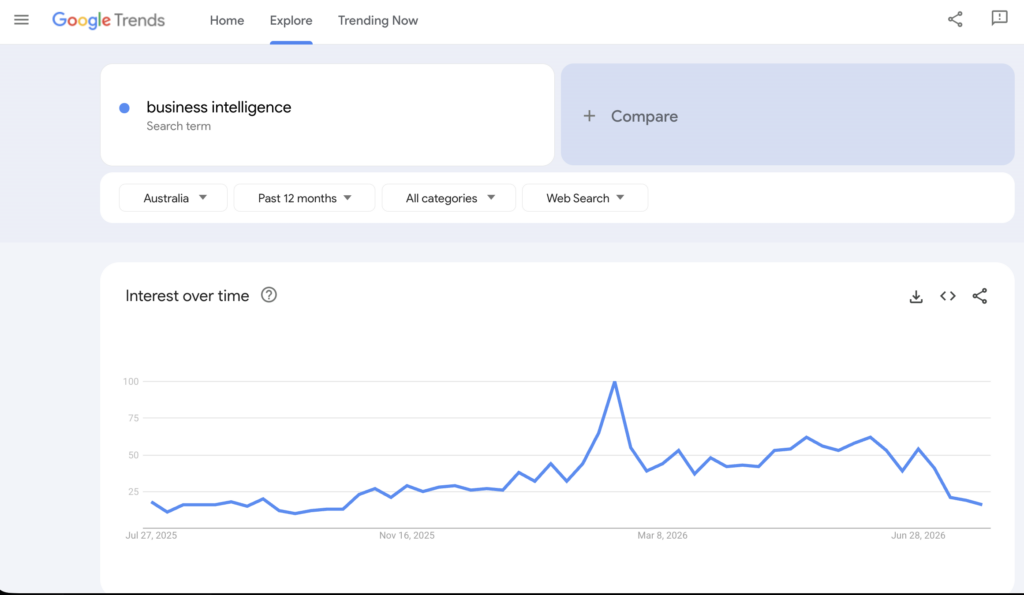
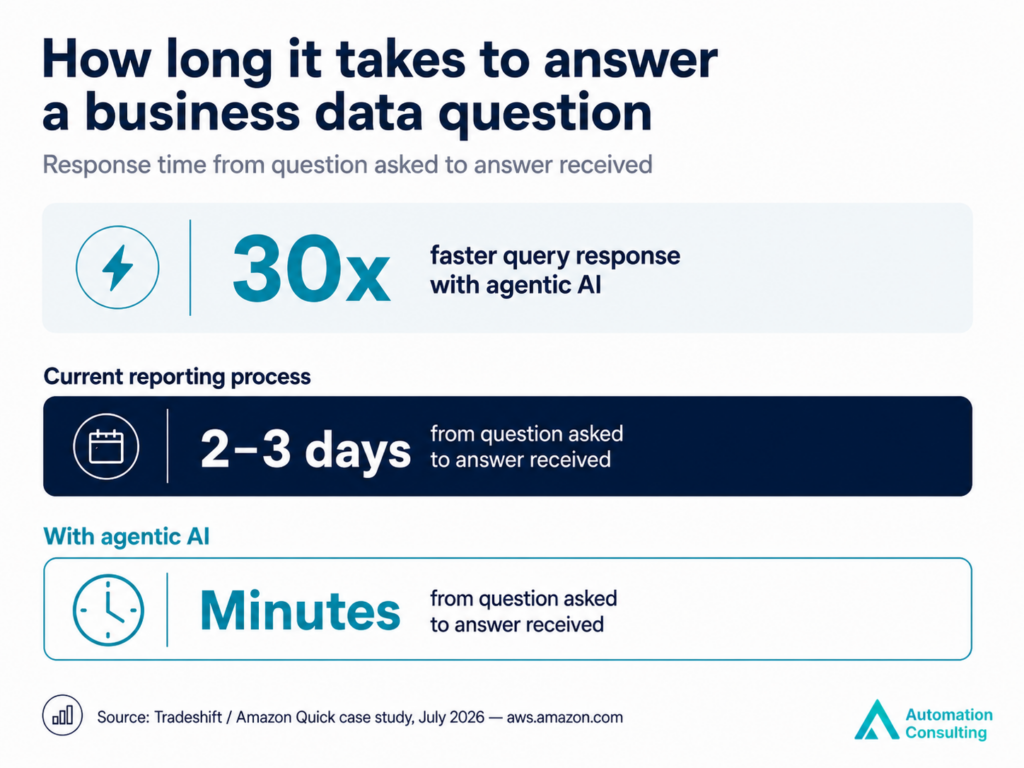
What removing the translation layer looks like
Agentic AI applied to business reporting replaces the translation layer with direct, natural language access to data. A business user asks a question in plain English. The system queries the relevant data, runs the analysis, and returns an answer without a human intermediary at any step.
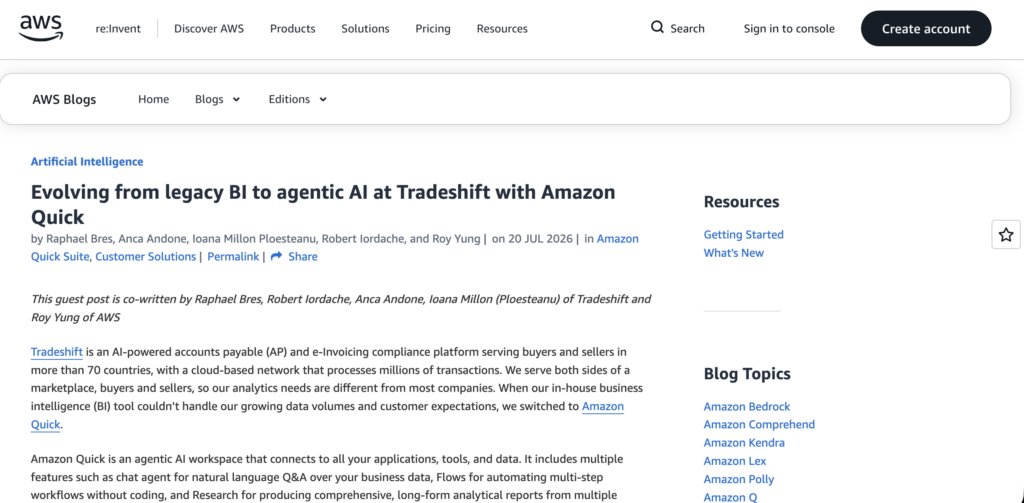
Tradeshift, an accounts payable and e-invoicing platform, replaced its in-house BI tool with an agentic AI system. Query response times improved by up to 30 times. Total cost of ownership fell by 40 per cent. Their analytics function, previously a cost centre, became a revenue-generating product.
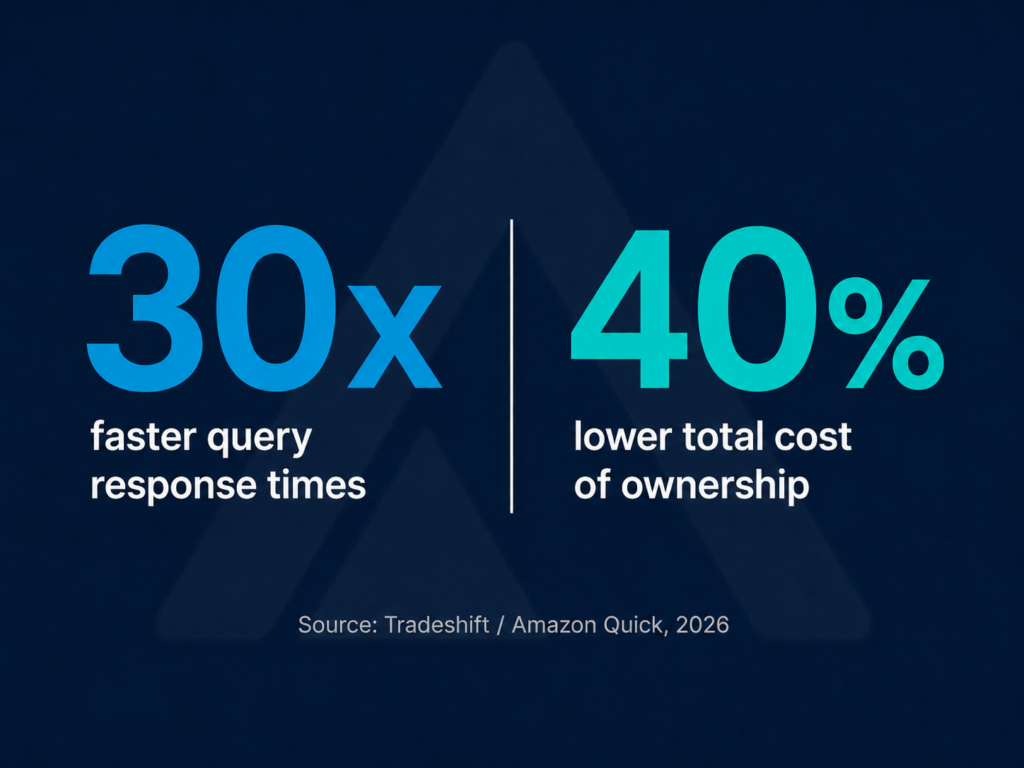
The outcome was not a better dashboard. Instead, it was the elimination of the queue. The result is real-time analytics and reporting that scales without adding analyst headcount.
What this looks like across industries
The translation layer shows up differently depending on the business, but the structural failure is the same.
Retail and ecommerce
The data questions a retail or ecommerce team asks are operational, not analytical. Sell-through rates, stock levels by location, margin by SKU, return rates on last week’s promotion. These are not questions that can wait three days. They have trade windows. A markdown call made on Tuesday about stock that should have moved on Saturday is a missed margin recovery. A reorder trigger that fires a week after sell-through data was available is a stockout. Most retail businesses are making these decisions on instinct, or on data that no longer reflects current conditions, and they have blamed their BI tool for it. The tool is not the problem.
Banking and fintech
In financial services, the cost of the translation layer is higher than elsewhere. A risk team wanting to know current portfolio exposure is not limited by its dashboard. It is limited by the time it takes a data analyst to build a query against last night’s data. A compliance team that needs a transaction anomaly report to meet a regulatory deadline is waiting on a queue, not a tool. In fintech specifically, the problem compounds: fraud patterns change, customer behaviour shifts, and a reporting stack that requires a three-day translation cycle cannot surface signals quickly enough for them to be acted on. Reporting that lands 48 hours after a question was asked is not slow. In this context, it is structurally useless.
Real estate
Property management and real estate businesses sit on significant operational data: vacancy rates, lease expiry schedules, maintenance costs by asset, rental yield by location. The problem is not a shortage of data. Rather, it is access to it. A portfolio manager wanting to know which properties have leases expiring in the next 90 days, and what comparable market rents look like, will typically wait two to three days for an answer. By the time the report lands, renewal conversations may already have started without the market rate data. The translation layer does not just slow the answer. Instead, it means the decision is made without the information that existed to support it.
Professional services
Consulting, accounting, legal, and engineering firms run on utilisation, margin, and pipeline. A principal wanting to know current utilisation across a division, or whether a specific engagement is tracking to budget, typically waits until the next weekly finance review. The resourcing decision it was meant to inform needed to be made mid-week. It arrived on Friday. The firm may have a practice management platform, a project accounting system, and a BI tool. None of those investments address the translation layer, because the layer exists in the process, not the software. However, hiring another analyst increases capacity within the layer. It does not remove it.
Across each of these industries, the pattern is the same. The fix is real-time analytics and reporting that removes the intermediary from the loop.
How to audit your own reporting stack
Before evaluating any new tooling, map one data request from the past week. Work through four questions:
Who originally asked the question? Who else had to touch it before an answer was produced? How long did it take from question to answer? Does the answer that arrived match the question that was originally asked?
If the request required more than two people or more than 24 hours, a translation layer is present. Yet changing the BI tool will not solve it. Run this as a workflow audit. It takes under ten minutes and tells you whether the problem is structural.
If you want to know what removing that layer would look like in your specific stack, that is the scope of our 20 hours free programme. We map the reporting workflow, identify where the translation layer sits, and show you exactly what removing it requires. No cost.
A BI translation layer is the series of human steps required to convert a business question into a data query and back into a readable answer. In most organisations this involves at least a business user, a data analyst, and a report build step, each of which introduces latency and the risk of the original question being distorted.
Agentic AI connects directly to business data and allows users to ask questions in plain language, removing the need for a human intermediary to write queries or build reports. The result is faster answers, lower overhead, and fewer errors introduced by interpretation at each handoff.
Upgrading a BI tool addresses platform performance or interface usability. Removing the translation layer eliminates the human steps between a business question and an answer entirely. The two are not equivalent, and most BI upgrade projects do not touch the translation layer.
Map a recent data request. If it required more than two people or more than 24 hours from question to answer, a translation layer is present. If the answer that arrived did not precisely match the question originally asked, the layer is also distorting outputs.
We assess the reporting workflow, identify where the translation layer sits, and design an approach to remove it using workflow automation and agentic AI where appropriate. Our 20 hours free programme covers this scoping at no cost.
See more Automation Consulting insights in your search results
Tell Google you’d like more of our thinking, and the next piece turns up where you’re already looking.