Demand is growing. Deals are getting bigger. But every new customer seems to need another hire, another spreadsheet, another manual handover. That’s the problem AI automation services solve: handling more work without costs rising at the same rate.
The right AI automation company depends on the provider’s expertise, the tools it works with, how well it knows your industry, and whether it offers strategy, implementation or both. This guide covers what AI automation services are, what they can automate, how to choose a provider, and six of the strongest options in Australia.
What are AI automation services?
AI automation services design, build and run systems that combine artificial intelligence with workflow tools to handle manual, repetitive business tasks. They include AI agents, automated workflows, document processing, chatbots and integrations between your business systems.
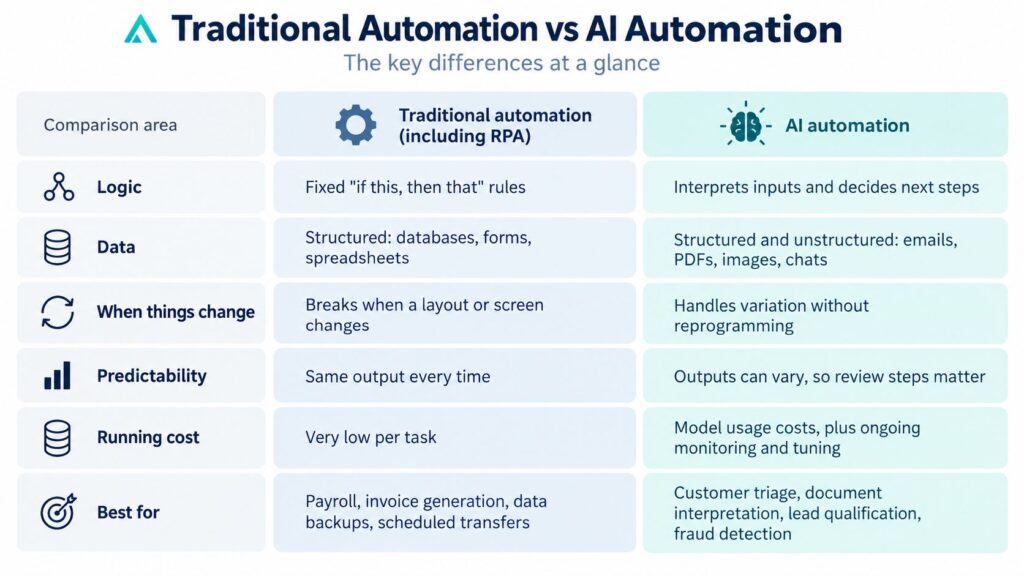
Traditional automation, including robotic process automation (RPA), follows fixed rules: if X happens, do Y. AI automation uses language models and machine learning to read unstructured information such as emails, PDFs and chat messages, work out what’s needed, and take the next step.
What do AI automation companies do?
| Service | What it can automate |
|---|---|
| AI strategy and audits | Mapping workflows, prioritising by return, building the roadmap |
| AI workflow automation | Approvals, notifications, data syncing, multi-step processes |
| AI agent development | Agents that research, answer questions, update records and complete tasks |
| Customer service automation | 24/7 chatbots, AI receptionists, ticket routing, qualifying questions by chat or voice, CRM updates |
| Document processing | Extracting data from invoices, contracts, forms and applications |
| Data and analytics automation | Live dashboards, scheduled reports, forecasting, alerts |
| System integration | Connecting CRM, ERP, accounting and e-commerce platforms |
| Support and optimisation | Monitoring, fixes, model updates and improvements after launch |
How to choose the right AI automation company
Step by step:
- Define the outcome: capacity, response time, cost per transaction or revenue.
- Match the type of automation: Rule-based workflows, AI agents and predictive analytics need different skills. Pick a provider that specialises in what you need.
- Check proof: Ask for live systems, named clients and results, ideally in your industry or on your stack.
- Check compliance: Ask how they handle access controls, encryption, data location.
- Check commercial terms: Look for a fixed-price first build, milestone reviews, and clear ownership of code, workflows and API credentials.
- Start with one workflow: Prove the return, then expand.
Before signing with any AI automation company, ask these 7 questions
- What result will this deliver, and how will we measure it?
- Can you show us a system you’ve built that’s running now?
- Who owns the workflows, code and API credentials?
- Where is our data processed and stored?
- What happens when the AI gets something wrong, and who reviews it?
- What will it cost to run each month, including hosting, API usage, licences and support?
- Who will we work with day to day?
How we selected these AI automation companies
We assessed each provider on 8 criteria:
- AI and automation expertise: a track record with AI agents, machine learning, generative AI and workflow automation.
- Industry experience: work in specific sectors, so the provider understands the processes before automating them.
- Technology and integration: the platforms it works with and how it connects to CRM, ERP, accounting and cloud systems.
- Security and AI governance: data protection, Privacy Act readiness, access controls and human oversight.
- Client results and scalability: named clients, published outcomes, and systems that grow with more users and data.
- Strategy, implementation or both: whether it helps decide what to automate, builds it, or does both.
- Maintenance and support: monitoring, updates and improvements after launch.
- Team: the depth of the team and who clients work with.
The 6 best AI automation companies in Australia
1. Automation Consulting
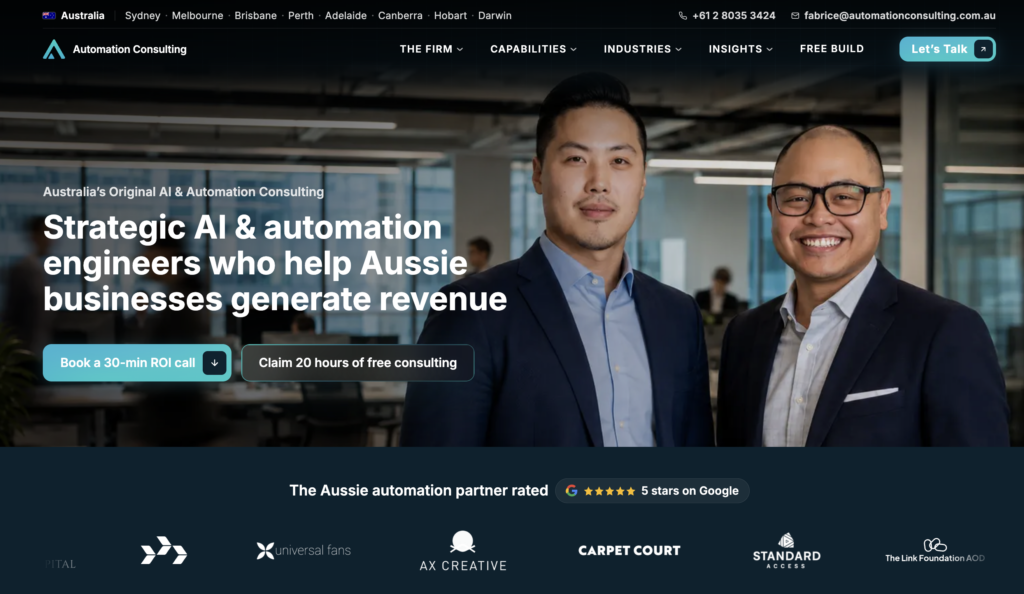
Automation Consulting is an AI and automation consultancy based in Sydney and Melbourne. It combines growth strategy with implementation: it works out where the business needs to grow, which processes are worth changing, then designs and builds the AI, automation and systems to get there.
It’s built for businesses with rising sales and deal volume. Automation Consulting helps scaling Australian businesses capture that growing demand and revenue without adding headcount or costs at the same rate. Beyond AI, it covers the systems scaling businesses outgrow and offers fractional CTO support for businesses without in-house technical leadership.
Core services:
- AI strategy and workflow audits
- AI automation and AI agents
- Process automation and systems integration
- ERP consulting, custom software and e-commerce development
- Fractional CTO
What sets it apart:
- Strategy and build from one team: The people who shape the plan deliver it, across any platform.
- A low-risk start: up to 20 hours of free build work, so your first automation is delivered before you commit to a project.
Best for: growing businesses that need both growth strategy and implementation.
2. Adaptiv
Adaptiv is a data, integration and AI consultancy serving enterprise organisations in Australia and New Zealand. It focuses only on integration, data and AI, and says it isn’t tied to any vendor. It offers advisory, implementation and managed services as a single partner across the full lifecycle.
Core services:
- System, data and application integration
- API strategy and management
- Data platforms and analytics
- AI solutions built on integrated data
- 24/7 managed support
What sets it apart:
- One of few Boomi Platinum Partners globally, with MuleSoft, Solace and Microsoft capability.
- Deep focus: Integration and data are all it does.
Best for: enterprises with complex integration, data and AI environments.
3. The Missing Link
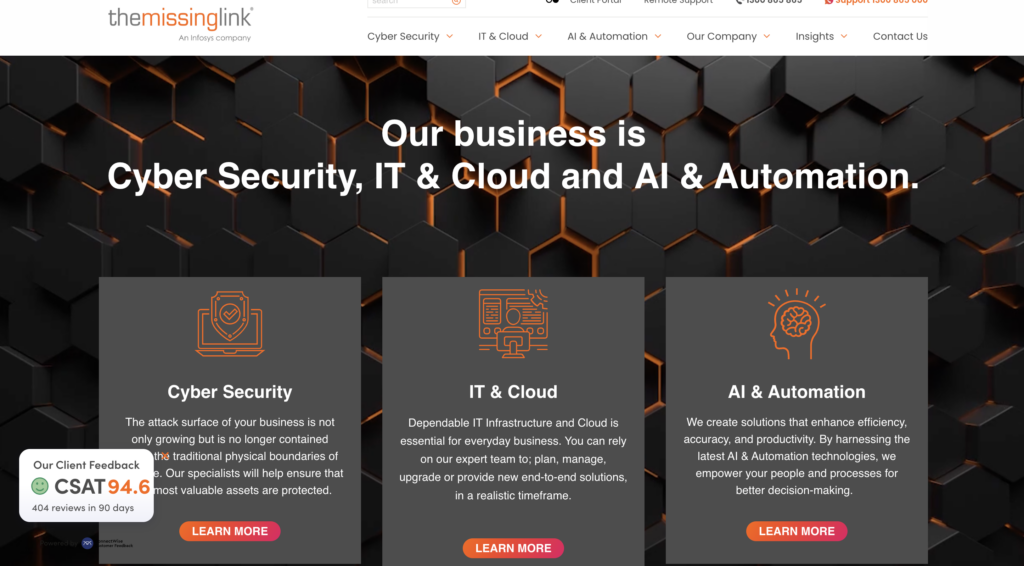
The Missing Link is a Sydney-headquartered IT firm. Infosys acquired it for $98 million in 2025. It continues to operate under its own name, with offices in Sydney, Melbourne and the UK. It runs three divisions: Cybersecurity, IT & Cloud, and AI & Automation. It launched its robotic process automation division in 2019, building on a security practice it started in 2013.
Core services:
- Intelligent automation with UiPath and Power Automate
- Generative AI and Microsoft 365 Copilot
- Cyber security, including red and blue teams and a global security operations centre
- IT and cloud services
- Managed services
What sets it apart:
- A security-first approach to automation, backed by a mature cyber practice.
- Access to Infosys’s global resources while keeping local leadership.
Best for: organisations where security and compliance come first.
4. Arinco
Arinco is a Microsoft specialist. It works across government, financial services, healthcare, retail and utilities, covering AI, data, Azure cloud, security, modern work and digital apps. In 2025 it integrated D6 Consulting, adding business consulting and program management to its technical delivery.
Core services:
- Copilots, AI agents and AI applications on Azure
- Data platforms (Microsoft Fabric, Azure Databricks)
- Azure cloud and security
- Microsoft 365 and Copilot adoption
- “Co-Ops” managed services that keep optimising cost, security and performance
What sets it apart:
- Deep Microsoft credentials and early access to Microsoft programs and funding.
- Its “Done Right” delivery framework, which focuses on governance and security foundations before AI.
Best for: organisations committed to Microsoft 365 and Azure.
5. Mantel
Mantel is an Australian-owned technology consultancy. Its AI and data work was built through Eliiza, its former AI brand, which has been folded into Mantel. Mantel works on large, multi-discipline programs where AI depends on modern data and cloud foundations.
Core services:
- AI and machine learning solutions
- Data platforms and analytics
- Cloud migration and engineering
- Digital product design and development
- Cyber security
What sets it apart:
- Breadth, with several disciplines under one Australian-owned firm.
- Strong partner status across the major cloud and data platforms.
Best for: large organisations running programs that span AI, data and cloud.
6. Accenture
Accenture is one of the world’s largest consulting and technology firms. It has partnerships with both OpenAI and Anthropic. In Australia, it works with ASX 50 companies and federal government departments. Its August 2025 acquisition of Australian cyber security firm CyberCX added local security depth.
Core services:
- AI strategy and enterprise transformation
- Agentic AI and automation at enterprise scale
- Cloud, data and systems integration
- Cyber security, through CyberCX
- Business process outsourcing
What sets it apart:
- Global scale, with teams that can run programs across many business units and countries at once.
- Partnerships with major AI and platform vendors, including OpenAI, Anthropic and ServiceNow.
Best for: large enterprises and government agencies running enterprise-wide transformation.
Comparison table
| Provider | Platforms | Typical customer | Best for |
|---|---|---|---|
| Automation Consulting | Platform-agnostic | SME to mid-market | Scaling operations |
| Adaptiv | Platform-agnostic; Boomi, Azure, MuleSoft, Databricks | Mid-market to enterprise | Integration/data |
| The Missing Link | UiPath, Microsoft | Mid-market to enterprise | Security-led automation |
| Arinco | Microsoft only | Mid-market to enterprise | Microsoft AI |
| Mantel | Google, AWS, Databricks, Snowflake | Enterprise | Large AI/data programs |
| Accenture | Platform-agnostic | Large enterprise/government | Enterprise transformation |
Why AI automation matters for Australian businesses in 2026
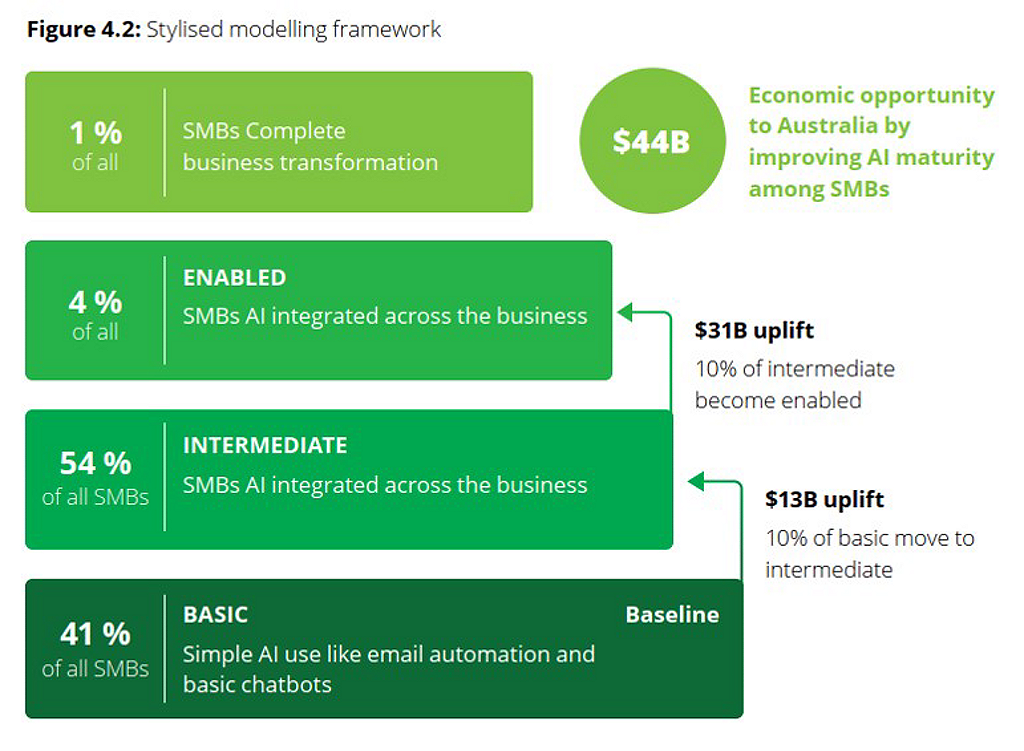
Australian adoption is high. 44% of Australian SMEs reported adopting AI in February 2026. But mature use is much rarer. Deloitte Access Economics found that while two-thirds of SMBs use AI, only 5% are fully enabled to benefit from it. That means having an AI strategy built into core processes, trained staff, and centralised data.
Time savings are real, but there’s a catch
In the Australian Government’s Microsoft 365 Copilot trial, public servants saved around an hour a day on tasks like summarising and searching information. Some of that time went into checking AI output for errors. That’s why well-built automation includes review steps.
Moving up pays off
Deloitte’s modelling suggests businesses moving from basic to intermediate AI use could see profitability rise about 45%, and about 111% for those moving from intermediate to fully enabled. Tools alone don’t get you there. What’s missing is the work around the tools: redesigning workflows, connecting systems, cleaning up data, setting governance, and getting automations into production.
That’s where an AI automation company comes in. A good provider decides what’s worth automating, builds it into your existing systems, adds review steps where the AI could get things wrong, and keeps it running after launch.
Does your business need AI automation?
Signs you’re ready:
- Your team spends hours each day on data entry, scheduling or copying information between apps.
- Leads go cold because replies to enquiries take too long.
- Sales are growing, but you can’t justify hiring more people just for routine work.
- Reports take days to pull together from different systems.
- Staff answer the same customer questions repeatedly.
When to skip AI and use simple automation:
- The task follows fixed rules. Moving a form submission into a spreadsheet doesn’t need AI.
- Every job is completely different, with no repeatable pattern.
- You can’t describe the process in a few steps. Fix the process first. Automating a broken process only speeds up the mess.
- The decision is high-stakes and hard to review, and you can’t put a person in the loop.
You can also check with our Automation Readiness Assessment tool.
Industries using AI automation in Australia
| Industry | Common uses | Australian example or data |
|---|---|---|
| Financial services | Fraud detection, compliance checks, onboarding, document review | CBA’s AI fraud detection helped cut fraud losses by over 20% in H1 FY26 |
| Healthcare | Patient intake, scheduling, clinical admin, imaging support | Health is among the highest-adopting sectors |
| Retail and e-commerce | Customer service, order updates, demand forecasting, recommendations | Tech Council modelling: $3 billion to $9 billion a year by 2030 |
| Manufacturing | Predictive maintenance, production reporting, supply chain updates | Tech Council modelling: $2 billion to $5 billion a year by 2030 |
| Logistics and warehousing | Route planning, shipment tracking, data entry, fulfilment | Automated document and order handling |
| Professional services | Onboarding, document drafting, billing, knowledge search | Tech Council modelling: $5 billion to $13 billion a year by 2030 |
| Construction | Quotes, scheduling, safety documentation, progress claims | Adoption below 30%, so early movers gain an edge |
| Energy and utilities | Field job scheduling, asset reporting, customer enquiries | Compliance and maintenance records |
| Facilities management | Work order routing, contractor scheduling, maintenance reporting | High-volume job admin |
| Real estate | Enquiry handling, inspection bookings, CRM follow-up | Lead response and follow-up |
The CBA example shows good practice: its AI agent proposes new fraud rules, but the fraud team checks and signs them off before they go live.
How Australian businesses use AI automation services
Most start with internal efficiency. Among SME adopters, content generation and data analytics are the most common uses, each cited by 54%.
The common uses:
- Workflow automation built on n8n, Make or Zapier, with AI handling data entry and routing.
- Chatbots and voice agents answering routine questions around the clock.
- Document processing that reads invoices, PDFs and technical documents.
- Built-in AI in platforms like Xero and HubSpot for reconciliation, categorisation and lead scoring.
- Microsoft Copilot for drafting, summarising and searching internal information.
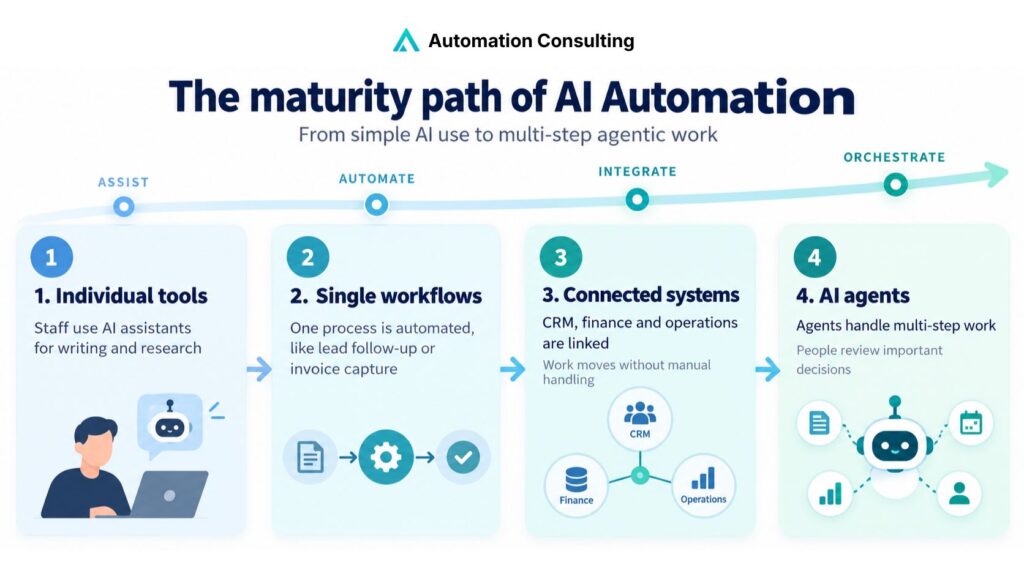
The maturity path:
- Individual tools: Staff use AI assistants for writing and research.
- Single workflows: One process is automated, such as lead follow-up or invoice capture.
- Connected systems: CRM, finance and operations are linked, so work moves without manual handling.
- AI agents: Agents take on multi-step work, with people reviewing important decisions.
Deloitte’s 5% “fully enabled” figure suggests most businesses sit at steps 1 or 2. The bigger returns come at steps 3 and 4, which is usually where a provider adds the most value.
Frequently asked questions
1. What are AI automation services?
AI automation services design, build and run systems that combine artificial intelligence with workflow tools to handle manual, repetitive business tasks. They include AI agents, automated workflows, document processing, chatbots and integrations between your business systems.
RPA follows fixed rules to repeat structured tasks and breaks when a screen or layout changes. AI automation reads unstructured information such as emails and PDFs, interprets it and decides the next step. RPA is predictable and cheap to run. AI handles variation but needs review steps and ongoing tuning. Most strong builds combine both.
To increase capacity without increasing headcount at the same rate. It’s one of the main commercial reasons businesses invest in automation. A provider also brings the strategy, integration, compliance and support that off-the-shelf tools don’t.
Yes. 44% of Australian SMEs were adopting AI in February 2026, and Deloitte found that SMBs moving from basic to intermediate AI use could lift profitability by about 45%. SMEs get the best return by starting with one workflow that takes significant staff time, then expanding once it pays off.
A single workflow usually goes live in a few weeks. Programs that span several systems are rolled out in phases over a few months. Timelines depend mostly on the number of integrations and how clean your data is.
Get your first automation built free
We’ll put up to 20 hours of real build work into your business at no cost. We’ll find the workflow costing you the most time or revenue and build the automation, so you see results before you commit to anything.
See more Automation Consulting insights in your search results
Tell Google you’d like more of our thinking, and the next piece turns up where you’re already looking.